
Salah, commonly translated as prayer, is the backbone of Islamic worship and the most consistent act of obedience required from a Muslim. It is the second pillar of Islam and the first practical expression of faith after belief in Allah and His Messenger ﷺ. Through prayer, a Muslim maintains a living connection with Allah, seeks forgiveness, disciplines the soul, and aligns daily life with divine guidance. Without Salah, faith weakens, and the heart gradually drifts away from remembrance of Allah.
Unlike other acts of worship that are tied to specific times or conditions, prayer is obligatory five times every day and night. It was prescribed directly by Allah during the miraculous Night Journey (Al-Isrā’ wal-Mi‘rāj), highlighting its unmatched importance. The Messenger of Allah ﷺ emphasized that prayer will be the first deed examined on the Day of Judgment, underscoring its foundational status in Islam.
Understanding the Classification of Prayers in Islam
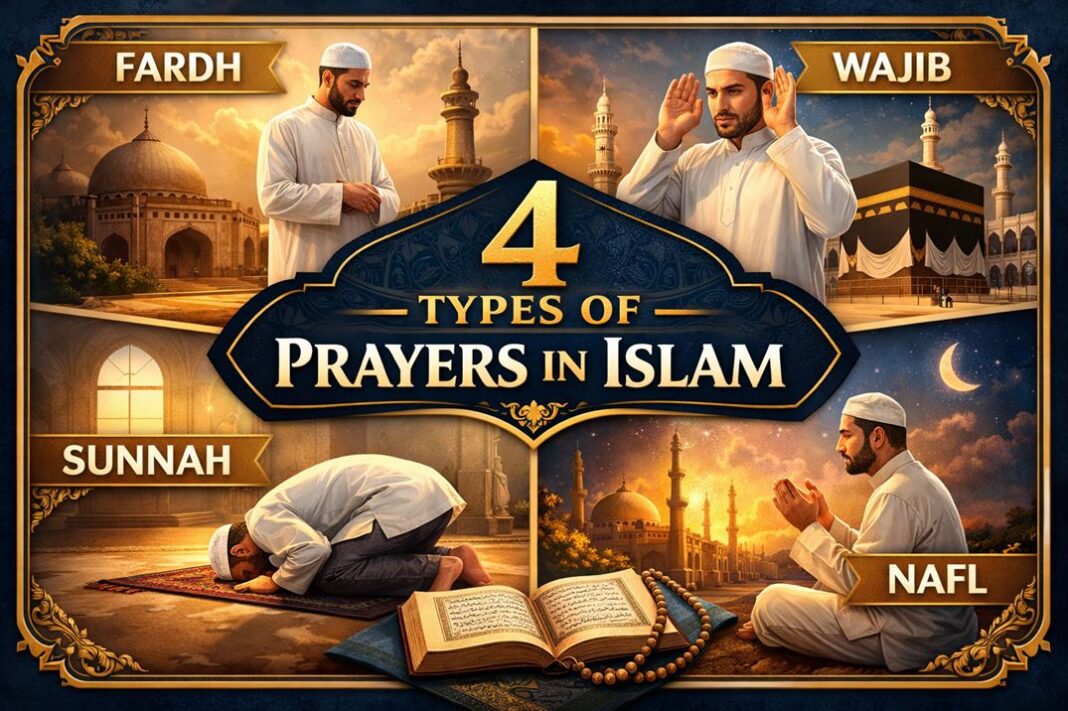
Islamic jurisprudence (Fiqh) categorizes prayers according to their level of obligation, evidence, and consequence. According to the Hanafi school of thought, prayers are divided into four distinct types: Fard, Wajib, Sunnah, and Nafl. Each category carries a different ruling, reward, and level of accountability before Allah.
It is important to note that Imam Abu Hanifah (رحمه الله) made a clear distinction between Fard and Wajib, while other schools of Islamic law often merge Wajib with Fard or Sunnah Mu’akkadah. This article follows the Hanafi classification for clarity and educational benefit.
Allah’s Commandments Regarding Daily Salah in the Qur’an
Salah is not a personal choice or cultural practice; it is a direct command from Allah. The Qur’an repeatedly emphasizes establishing prayer at specific times throughout the day, making it clear that prayer structures a believer’s entire life.
Allah says:
Arabic:
وَأَقِمِ الصَّلَاةَ طَرَفَيِ النَّهَارِ وَزُلَفًا مِّنَ اللَّيْلِ
Translation:
“And establish prayer at the two ends of the day and at the approach of the night.”
(Surah Hud 11:114)
This verse refers to multiple daily prayers and highlights the rhythm of worship from morning to night.
Allah further says:
Arabic:
أَقِمِ الصَّلَاةَ لِدُلُوكِ الشَّمْسِ
Translation:
“Establish prayer at the decline of the sun.”
(Surah Al-Isra’ 17:78)
Additionally, Allah emphasizes protecting the prayers, especially the middle one:
Arabic:
حَافِظُوا عَلَى الصَّلَوَاتِ وَالصَّلَاةِ الْوُسْطَى
Translation:
“Guard strictly all the prayers, especially the middle prayer.”
(Surah Al-Baqarah 2:238)
These verses demonstrate that prayer is a non-negotiable obligation and must be observed with consistency and seriousness.
Fard Prayers in Islam: The Absolute Obligation
What Is Fard Prayer?
The word Fard (فرض) literally means compulsory or mandatory. In Islamic law, Fard prayers are those whose obligation is established by clear and decisive evidence from the Qur’an or mass-transmitted Sunnah. Performing Fard prayers is mandatory for every adult, sane Muslim, and abandoning them intentionally is considered a major sin.
READ MORE: How to Prepare Spiritually for Jumu’ah Prayer: A Step-by-Step Guide for Muslims
Denying the obligation of a Fard prayer removes a person from the fold of Islam because it amounts to rejecting a clear command of Allah.
Importance of Fard Prayer in the Sunnah
The Prophet Muhammad ﷺ warned severely against abandoning obligatory prayer. He said:
Arabic:
بَيْنَ الرَّجُلِ وَبَيْنَ الشِّرْكِ وَالْكُفْرِ تَرْكُ الصَّلَاةِ
Translation:
“Between a man and disbelief or polytheism is the abandonment of prayer.”
(Sahih Muslim)
This hadith shows that neglecting prayer is not a minor issue but a threat to one’s faith itself.
The Five Daily Fard Prayers
Allah has made five daily prayers obligatory upon Muslims: Fajr, Zuhr, ‘Asr, Maghrib, and ‘Isha’. Each prayer has a fixed number of rak‘āt and a prescribed time. These prayers divide the day into moments of remembrance, ensuring that a believer never goes long without turning back to Allah.
The Five Daily Fard Prayers
| Prayer | Number of Rak‘āt |
|---|---|
| Fajr | 2 |
| Zuhr | 4 |
| ‘Asr | 4 |
| Maghrib | 3 |
| ‘Isha’ | 4 |
These prayers are mandatory upon every adult, sane Muslim, male and female.
READ MORE: The Transformative Benefits of Prayer (Salah) in Islam: A Complete Guide
Missing a Fard prayer intentionally without a valid excuse is a grave sin. However, Islam also recognizes human weakness. If a person misses a prayer due to sleep or forgetfulness, they are required to make it up as soon as they remember.
The Prophet ﷺ said:
Arabic:
مَنْ نَسِيَ صَلَاةً فَلْيُصَلِّهَا إِذَا ذَكَرَهَا
Translation:
“Whoever forgets a prayer must offer it when he remembers it.”
(Sahih al-Bukhari)
Wajib Prayers in Islam: Necessary but Lesser Than Fard
Meaning and Ruling of Wajib Prayer
Wajib (واجب) refers to prayers that are necessary and binding, but whose obligation is proven by evidence slightly less decisive than that of Fard. According to the Hanafi school, missing a Wajib prayer intentionally is sinful, though the sin is less severe than missing a Fard prayer.
Denying a Wajib prayer does not constitute disbelief, but it is considered misguidance and a serious error.
Examples of Wajib Prayers
Among the most well-known Wajib prayers are Salat al-Witr, the Eid prayers, and the two rak‘āt offered after completing Tawaf around the Ka‘bah. These prayers hold great significance in Islam and were consistently observed by the Prophet ﷺ.
Salat al-Witr: The Most Emphasized Wajib Prayer
Salat al-Witr consists of three rak‘āt and is offered after the ‘Isha’ prayer. The Prophet ﷺ never abandoned Witr, whether he was traveling or staying at home. Its importance is highlighted in the following hadith:
Arabic:
إِنَّ اللَّهَ قَدْ أَمَدَّكُمْ بِصَلَاةٍ هِيَ خَيْرٌ لَكُمْ مِنْ حُمْرِ النَّعَمِ، الْوِتْرُ
Translation:
“Allah has granted you a prayer that is better for you than red camels: the Witr prayer.”
(Sunan Abi Dawud)
In the final rak‘ah of Witr, Muslims recite Du‘a al-Qunut, a powerful supplication expressing reliance on Allah, gratitude, hope for mercy, and fear of His punishment.
Du‘a al-Qunut (Arabic and Translation)
Arabic:
اللَّهُمَّ إِنَّا نَسْتَعِينُكَ وَنَسْتَغْفِرُكَ وَنُؤْمِنُ بِكَ وَنَتَوَكَّلُ عَلَيْكَ…
Translation:
“O Allah, we seek Your help and forgiveness. We believe in You and rely upon You. We praise You in the best manner and thank You, and we are not ungrateful to You. We abandon those who disobey You. O Allah, You alone do we worship, to You alone do we pray and prostrate. We hope for Your mercy and fear Your punishment, for surely Your punishment overtakes the disbelievers.”
Sunnah Prayers in Islam: Following the Practice of the Prophet ﷺ
After Fard and Wajib prayers, Islam places great emphasis on Sunnah prayers, which are acts of worship established through the consistent practice of the Prophet Muhammad ﷺ. Sunnah prayers are not merely optional extras; they are powerful means of drawing closer to Allah, compensating for deficiencies in obligatory prayers, and attaining the love of Allah through imitation of His Messenger ﷺ.
The Prophet ﷺ said:
Arabic:
مَنْ رَغِبَ عَنْ سُنَّتِي فَلَيْسَ مِنِّي
Translation:
“Whoever turns away from my Sunnah is not from me.”
(Ṣaḥīḥ al-Bukhārī)
This statement shows that adherence to Sunnah is not trivial. It reflects sincerity, obedience, and love for the Prophet ﷺ.
Categories of Sunnah Prayers: Mu’akkadah and Ghair Mu’akkadah
Sunnah prayers are divided into two categories based on how consistently the Prophet ﷺ observed them: Sunnah Mu’akkadah and Sunnah Ghair Mu’akkadah.
Sunnah Mu’akkadah: The Emphasized Sunnah
Sunnah Mu’akkadah refers to those prayers that the Prophet ﷺ performed regularly and rarely omitted. According to the Hanafi school, deliberately and habitually neglecting Sunnah Mu’akkadah is blameworthy and sinful, though not at the level of abandoning Fard or Wajib prayers.
These prayers hold immense importance because they reflect the daily routine of the Prophet ﷺ and demonstrate a believer’s commitment to perfecting his worship.
The Sunnah Mu’akkadah prayers include the two rak‘āt before the Fard prayer of Fajr, which the Prophet ﷺ valued immensely. He said:
Arabic:
رَكْعَتَا الْفَجْرِ خَيْرٌ مِنَ الدُّنْيَا وَمَا فِيهَا
Translation:
“The two rak‘āt of Fajr are better than the world and everything in it.”
(Ṣaḥīḥ Muslim)
They also include four rak‘āt before Zuhr and two rak‘āt after it, two rak‘āt after Maghrib, and two rak‘āt after ‘Isha’. These prayers surround the obligatory prayers like protective barriers, strengthening concentration and humility in worship.
Sunnah Ghair Mu’akkadah: The Non-Emphasized Sunnah
Sunnah Ghair Mu’akkadah refers to prayers that the Prophet ﷺ performed occasionally, but not consistently. Performing them brings reward, while leaving them does not incur sin. These prayers still hold great virtue, as they were practiced by the Prophet ﷺ at times.
Examples include four rak‘āt before ‘Asr and four rak‘āt before ‘Isha’. The Prophet ﷺ said regarding the Sunnah before ‘Asr:
Arabic:
رَحِمَ اللَّهُ امْرَأً صَلَّى قَبْلَ الْعَصْرِ أَرْبَعًا
Translation:
“May Allah have mercy on the one who prays four rak‘āt before ‘Asr.”
(Sunan Abī Dāwūd)
This hadith shows that even non-emphasized Sunnah prayers attract Allah’s mercy when performed sincerely.
The Spiritual Role of Sunnah Prayers in Perfecting Salah
Sunnah prayers play a crucial role in repairing deficiencies in obligatory prayers. On the Day of Judgment, if a person’s Fard prayers are found lacking, Allah will command that the shortcomings be compensated through Sunnah prayers.
The Prophet ﷺ said:
Arabic:
إِنَّ أَوَّلَ مَا يُحَاسَبُ بِهِ الْعَبْدُ الصَّلَاةُ، فَإِنْ نَقَصَتْ قَالَ اللَّهُ: انْظُرُوا هَلْ لِعَبْدِي مِنْ تَطَوُّعٍ
Translation:
“The first deed for which a servant will be called to account will be prayer. If it is deficient, Allah will say: ‘See if My servant has voluntary prayers to complete it.’”
(Sunan Abī Dāwūd)
This hadith alone should motivate every believer to protect Sunnah prayers as spiritual insurance for the Hereafter.
Nafl Prayers in Islam: Voluntary Acts of Devotion
The fourth category of prayer in Islam is Nafl, also known as Nawafil prayers. Nafl prayers are voluntary acts of worship performed out of love for Allah and desire for extra reward. Unlike Fard, Wajib, or Sunnah prayers, missing Nafl prayers carries no sin, but performing them brings immense spiritual benefit.
Nafl prayers allow a believer to go beyond minimum obligations and develop a deeper, more intimate relationship with Allah. They are especially beloved by Allah, as mentioned in the famous Hadith Qudsi:
Arabic:
وَمَا يَزَالُ عَبْدِي يَتَقَرَّبُ إِلَيَّ بِالنَّوَافِلِ حَتَّى أُحِبَّهُ
Translation:
“My servant continues to draw closer to Me through voluntary acts until I love him.”
(Ṣaḥīḥ al-Bukhārī)
Tahajjud Prayer: The Night Prayer of the Righteous
Among all Nafl prayers, Salat al-Tahajjud holds the highest status. It is performed during the last portion of the night after waking from sleep. Tahajjud is the prayer of the prophets, the righteous, and those seeking closeness to Allah.
Allah praises those who pray at night in the Qur’an:
Arabic:
وَمِنَ اللَّيْلِ فَتَهَجَّدْ بِهِ نَافِلَةً لَّكَ
Translation:
“And during part of the night, pray Tahajjud as an extra act of devotion for you.”
(Surah Al-Isra’ 17:79)
The quiet of the night, combined with sincere supplication, makes Tahajjud a powerful means of forgiveness, acceptance of du‘ā’, and elevation of status.
Other Important Nafl Prayers in Daily Life
Beyond Tahajjud, Islam encourages many other Nafl prayers that integrate worship into daily routines. Salat al-Ishraq, offered shortly after sunrise, carries the reward of Hajj and ‘Umrah when prayed with remembrance. Salat ad-Duha is performed later in the morning and serves as a means of gratitude for the blessings of health and livelihood.
The Prophet ﷺ said:
Arabic:
يُصْبِحُ عَلَى كُلِّ سُلَامَى مِنْ أَحَدِكُمْ صَدَقَةٌ
Translation:
“Each joint of a person must perform charity every day.”
(Ṣaḥīḥ Muslim)
He then explained that two rak‘āt of Duha suffice as charity for all joints.
Other Nafl prayers include Salat al-Hajah for seeking needs, Salat al-Shukr for gratitude, and Tahiyyat al-Masjid, offered upon entering a mosque as a sign of respect for the house of Allah.
Forbidden Times for Nafl Prayers
Although Nafl prayers are flexible, Islam has set specific times during which voluntary prayers should not be offered, such as after ‘Asr until Maghrib and after Fajr until sunrise. This discipline preserves balance and obedience within voluntary worship.
Despite this, Nafl prayers are generally best performed at home, as the Prophet ﷺ encouraged private worship to strengthen sincerity, except for prayers specifically tied to the mosque.
Conclusion: Living a Complete Life of Prayer in Islam
Understanding the four types of prayers in Islam—Fard, Wajib, Sunnah, and Nafl—allows a Muslim to worship Allah with knowledge, balance, and sincerity. Fard prayers form the unshakable foundation of faith. Wajib prayers reinforce commitment and discipline. Sunnah prayers perfect worship and reflect love for the Prophet ﷺ. Nafl prayers elevate the soul and draw the servant closer to Allah.
A Muslim who guards all four types of prayer lives a life anchored in remembrance, humility, and obedience. Prayer is not a burden but a divine gift—a daily opportunity to reconnect with Allah, seek forgiveness, and renew faith.
May Allah make us among those who establish prayer consistently, protect it in its proper times, and perfect it inwardly and outwardly. Āmīn.