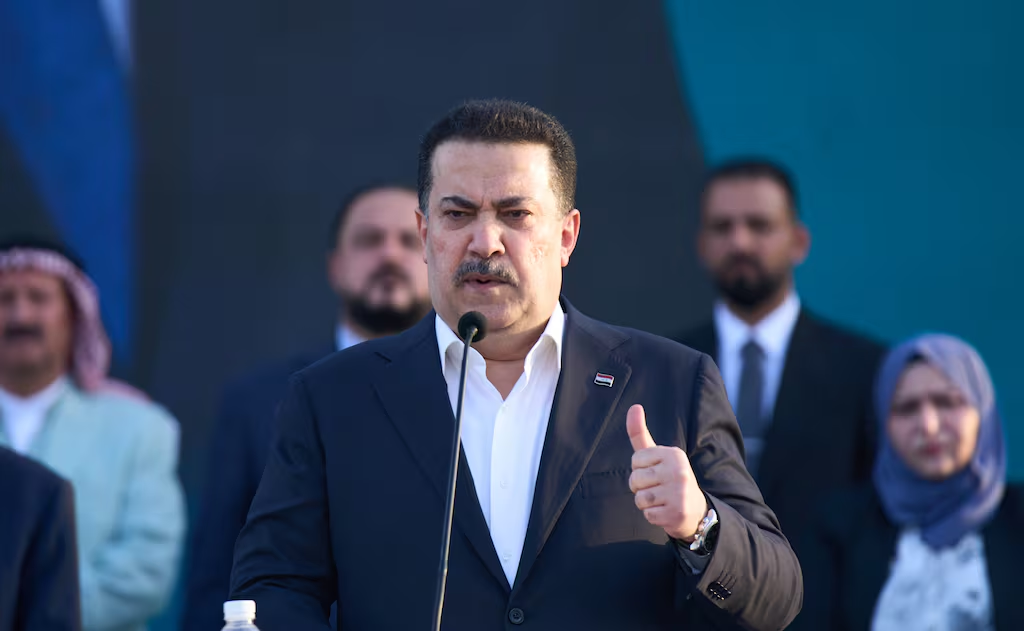

Baghdad — Iraq’s Prime Minister Mohammed Shia al-Sudani announced on Monday that a limited number of U.S. military advisers will remain stationed in Iraq for the time being, citing ongoing security concerns linked to Islamic State (IS) activity in neighboring Syria.
Under a previous agreement reached last year, both Washington and Baghdad had planned to conclude the U.S.-led coalition’s mission against IS in Iraq by September 2025, which included a full withdrawal of American forces from several Iraqi bases.
However, speaking to reporters in Baghdad, Prime Minister al-Sudani explained that recent developments in Syria have prompted Iraq to revise that plan. He confirmed that between 250 and 350 U.S. advisers and support staff will continue operating at Ain al-Asad Air Base in western Iraq, as well as at facilities near Baghdad International Airport and al-Harir Air Base in the north.
“The situation in Syria has evolved in a way that demands continued coordination and surveillance efforts against remnants of the Islamic State,” al-Sudani said.
The advisers will assist with intelligence gathering, counter-IS operations, and coordination with the al-Tanf base in Syria, where U.S. forces are still active. Meanwhile, other American outposts in Iraq are reportedly undergoing gradual reductions in personnel and operational activities.
Concerns Over Islamic State Resurgence
The move follows growing fears that the fall of former Syrian President Bashar al-Assad in a rebel offensive late last year could lead to instability, potentially giving IS militants room to reorganize. The collapse of Syrian government forces left behind a security vacuum and significant weapons stockpiles, raising alarms in Baghdad about the possibility of extremist infiltration across the border.
READ MORE: Three UK Neo-Nazis Sentenced for Plotting Attacks on Mosques and Synagogues to Spark “Race War”
Despite these concerns, al-Sudani emphasized that IS “no longer represents a major internal threat” within Iraq itself. The group, which once controlled vast territories across Iraq and Syria a decade ago, has been largely defeated but continues to pose sporadic security risks through sleeper cells.
Balancing Relations with the U.S. and Iran
Iraq continues to walk a delicate diplomatic line between the United States and Iran, seeking to maintain neutrality amid growing regional tensions.
“Our stance remains the same — Iraq will not serve as a battleground for external conflicts,” al-Sudani said. “We put Iraq first and refuse to act as a proxy for anyone.”
The prime minister also called on Washington to reopen diplomatic channels with Tehran, criticizing the U.S. “maximum pressure” policy under former President Donald Trump as ineffective.
“Iran is a key regional player that should be engaged through dialogue and mutual respect,” al-Sudani added.
Tensions Over Armed Groups and Political Integration
Relations between Baghdad and Washington have also been strained by the continued presence of Iran-backed militias within Iraq. The Popular Mobilization Forces (PMF) — a coalition of armed groups formed during the war against IS — was formally integrated into Iraq’s armed forces in 2016. However, many of its factions still operate with considerable autonomy.
The Iraqi parliament is currently debating a bill aimed at strengthening the legal framework between the PMF and the Iraqi military, a move that has drawn objections from Washington, which fears it could further increase Tehran’s influence.
While al-Sudani did not comment directly on the proposed legislation, he reiterated his administration’s commitment to “national dialogue and disarmament” as part of a broader effort to reduce internal conflict.
“We encourage all armed factions to either merge into state institutions or participate peacefully in political life,” he said, suggesting that former militant groups could register as political parties and contest upcoming elections.
Looking Ahead to Iraq’s Next Elections
With parliamentary elections scheduled for next month, al-Sudani is seeking a second term amid challenges of security reform, economic development, and political unity.
“Factions that have transitioned from armed groups to political organizations have the constitutional right to take part in elections,” he affirmed.
As Iraq continues its gradual security handover and navigates complex alliances, al-Sudani’s decision to retain a modest U.S. presence underscores both the fragility of regional stability and Iraq’s desire to safeguard its sovereignty while countering lingering extremist threats.