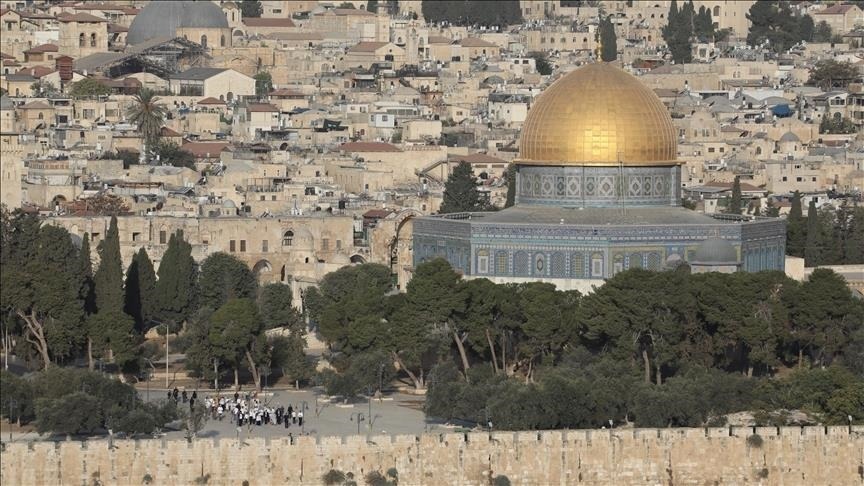

Israeli authorities are preparing to impose new restrictions on Muslim access to Al-Aqsa Mosque during the upcoming month of Ramadan, according to Sheikh Ekrima Sabri, former Grand Mufti of Jerusalem and head of the Supreme Islamic Council.
Speaking in an interview with Anadolu, Sheikh Sabri expressed deep concern over the anticipated measures, describing them as severe and harmful to Muslims’ ability to observe the holy month.
“Muslims traditionally welcome Ramadan with hope and spiritual readiness, following the example of the Prophet Muhammad,” he said. “But in Jerusalem, this joy is overshadowed by the harsh steps the occupying authorities intend to impose on worshippers coming to Al-Aqsa.”
New security leadership raises concerns
Sheikh Sabri noted that the intentions of Israeli authorities became clearer after the appointment of Maj. Gen. Avshalom Peled as police commander in occupied East Jerusalem earlier this year. The move is widely viewed as aligning with the agenda of far-right National Security Minister Itamar Ben-Gvir, who has repeatedly called for changes at the sensitive mosque compound.
READ MORE: Dubai Limits School Hours to Five Daily During Ramadan
The Israeli newspaper Haaretz previously reported that these actions appear aimed at escalating tensions at the site, describing efforts by senior officials to deliberately inflame the situation.
Entry bans and tighter controls expected
According to Sheikh Sabri, Israeli authorities have already barred dozens of young Palestinian men from entering Al-Aqsa and have indicated that restrictions on worshippers arriving from the occupied West Bank will not be relaxed during Ramadan.
“This signals even stricter limitations,” he said. “The number of worshippers will be significantly reduced compared to previous years. Such actions directly undermine freedom of worship and disrupt Muslims’ observance of the fasting month.”
Traditionally, hundreds of thousands of Palestinians from the West Bank travel to East Jerusalem during Ramadan to pray at Al-Aqsa. However, access has been increasingly restricted since the outbreak of the Gaza war in October 2023, with tighter military checkpoints and fewer entry permits issued.
Over the past two years, only limited numbers of Palestinians have obtained Israeli permits—documents residents describe as difficult and arbitrary to secure. As of now, no special Ramadan arrangements have been announced.
Temporary bans and political backlash
In recent days, Israeli authorities have also issued temporary exclusion orders against hundreds of East Jerusalem residents—mostly young men—preventing them from entering the mosque compound during Ramadan. Some of these bans reportedly extend for up to six months.
The measures come amid growing criticism of Israel’s right-wing government, led by Prime Minister Benjamin Netanyahu, which Palestinian officials accuse of altering the long-standing “status quo” governing Al-Aqsa Mosque.
Despite objections from the Islamic Waqf Department, Israeli police have allowed Jewish extremist groups to enter the compound under police protection since 2003, a practice Palestinians say violates established agreements.
Warnings over long-term intentions
“There is no doubt that the current government seeks to implement an aggressive agenda at Al-Aqsa,” Sheikh Sabri warned. “For years, these groups demanded public prayers, ritual practices, and open religious displays. What were once concealed ambitions are now openly declared.”
He added that Palestinians have long cautioned against efforts to impose Israeli sovereignty over the site while weakening the authority of the Islamic Waqf.
Wider impact on Jerusalem communities
Sheikh Sabri also highlighted that Israeli policies extend beyond Al-Aqsa to include widespread home demolitions in Palestinian neighborhoods across occupied East Jerusalem, particularly areas near the mosque.
“This demolition policy is discriminatory, unlawful, and inhumane,” he said, describing it as a continuation of colonial-era practices imposed during British rule in Palestine.
Concluding his remarks, Sheikh Sabri called on Arab and Muslim nations to provide meaningful support to Palestinians in Jerusalem and urged regional leaders to uphold their responsibility toward the city and the protection of Al-Aqsa Mosque.