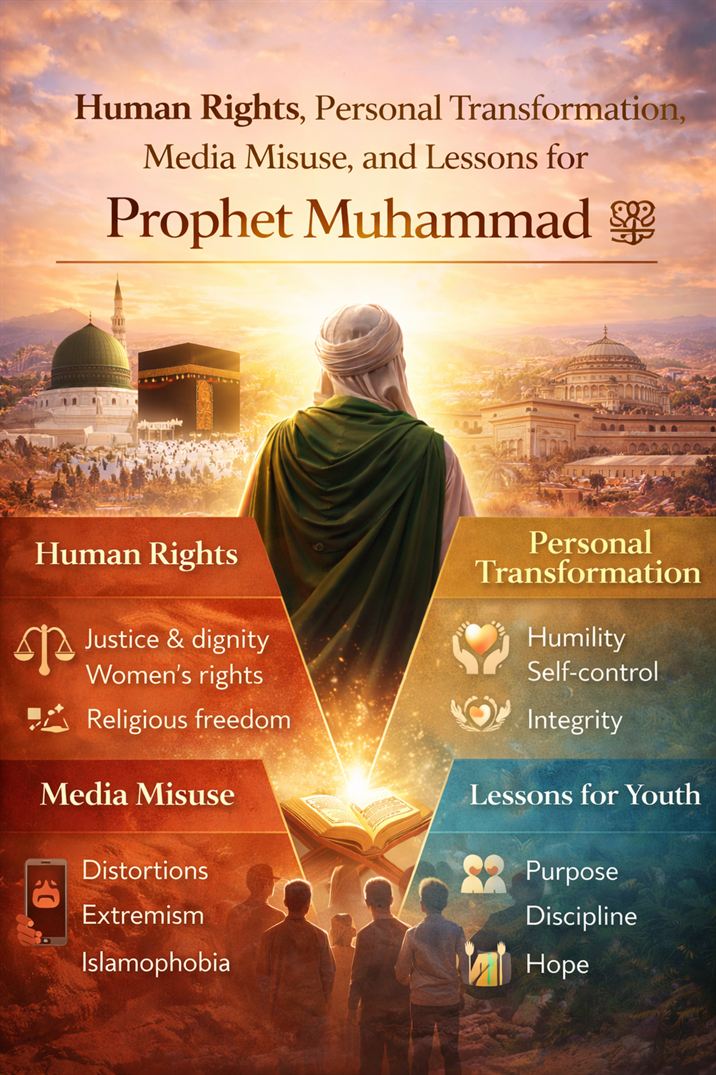

Learning from Prophet Muhammad (ﷺ) — Across centuries, cultures, and civilizations, the legacy of Prophet Muhammad has shaped moral thought, legal systems, and personal character. Yet in the modern world—where human rights discourse, media narratives, and youth identity crises dominate public conversation—his life is often misunderstood, selectively portrayed, or ignored altogether.
Learning from Prophet Muhammad (ﷺ)
This part of our series addresses four urgent questions:
-
What did Muhammad actually teach about human rights?
-
How does his life transform personal character?
-
Why is his image frequently misused in modern media?
-
What lessons does he offer today’s youth?
Together, these themes reveal why Muhammad’s example remains not only relevant—but necessary.
1. Muhammad and Human Rights: A Forgotten Pioneer
Human Rights Before the Modern Age
Human rights are often presented as a modern invention—emerging from 18th-century Europe or post–World War II declarations. Yet more than 1,400 years ago, Prophet Muhammad articulated principles that align closely with what we now call universal human rights.
READ MORE: Example Of Prophet In Islam: The Ideal Model for Humanity
These principles were not abstract ideals. They were implemented, enforced, and lived.
The Right to Life and Human Dignity
Muhammad taught that:
-
Every human life is sacred
-
Murder and oppression are among the gravest sins
-
Human dignity is inherent, not earned through race, wealth, or status
He abolished tribal superiority and declared that no race or ethnicity is superior to another.
Women’s Rights in a Patriarchal Society
At a time when women were denied basic dignity, Muhammad:
-
Prohibited female infanticide
-
Established women’s rights to inheritance
-
Required consent in marriage
-
Recognized women as moral and spiritual equals
These reforms were revolutionary in seventh-century Arabia and remain relevant in contemporary gender justice discussions.
Religious Freedom and Minority Protection
Muhammad upheld the rights of religious minorities:
-
Freedom of belief
-
Protection of places of worship
-
Equal justice under the law
Non-Muslims living under Muslim governance were guaranteed safety and dignity—an ethic that predates modern pluralism.
2. How the Seerah Transforms Personal Character
The Seerah—the life story of Prophet Muhammad—is not merely historical biography. It is a manual for character transformation.
From Ego to Humility
Muhammad demonstrated humility at every stage of life:
-
He sat with the poor
-
Accepted criticism
-
Lived simply even when power was available
His life challenges ego-driven ambition and promotes servant leadership.
Emotional Intelligence and Self-Control
He taught:
-
Anger should be restrained
-
Forgiveness is superior to revenge
-
Strength lies in patience, not dominance
These principles directly counter modern cultures of outrage, impulsiveness, and hostility.
READ MORE: Misconceptions vs Reality — Separating Truth from Myth About Prophet Muhammad (ﷺ)
Consistency Between Belief and Action
One of the most transformative aspects of the Seerah is integrity:
-
What Muhammad preached, he practiced
-
What he commanded, he embodied
This alignment between values and behavior is essential for authentic personal growth.
3. Misuse of Muhammad’s Image in Modern Media
Selective Storytelling and Sensationalism
In contemporary media, Prophet Muhammad is often:
-
Reduced to conflict-related narratives
-
Quoted without context
-
Associated with actions he explicitly condemned
This selective portrayal creates a distorted image that fuels misunderstanding and fear.
Extremism vs. Authentic Teachings
Violent groups frequently misuse Islamic language and symbols. Media outlets then amplify these voices while ignoring:
-
Mainstream Muslim scholarship
-
The ethical teachings of Muhammad
-
The lived reality of over a billion peaceful Muslims
Blaming Muhammad for extremism is both intellectually dishonest and historically inaccurate.
The Cost of Misrepresentation
This misuse results in:
-
Islamophobia
-
Dehumanization of Muslims
-
Breakdown of dialogue and trust
Correcting the narrative is not about censorship—it is about fairness, accuracy, and responsibility.
4. Lessons from Muhammad for Youth Today
Modern youth face challenges unprecedented in scale:
-
Identity confusion
-
Moral relativism
-
Mental health struggles
-
Pressure from social media and consumer culture

Prophet Muhammad offers guidance that speaks directly to these realities.
READ MORE: Is Prophet Muhammad ﷺ Mentioned in the Bible? Hidden Biblical Prophecies Revealed
Purpose Over Popularity
Muhammad taught that:
-
Self-worth is not measured by status or applause
-
Purpose comes from serving truth and humanity
In an age obsessed with validation, this lesson is liberating.
Discipline in a Distracted World
His life emphasized:
-
Structured prayer
-
Reflection
-
Mindful speech
These habits cultivate focus, resilience, and inner stability—qualities youth desperately need today.
Courage with Compassion
Muhammad modeled courage that was:
-
Ethical, not reckless
-
Compassionate, not cruel
Youth learn that standing for truth does not require abandoning mercy.
Hope in the Face of Hardship
Despite rejection, loss, and persecution, Muhammad remained hopeful and forward-looking. His optimism was grounded not in denial—but in trust, effort, and faith.
What the Qur’an Says About His Mission
The Qur’an describes Muhammad not as a controller of people, but as:
-
A reminder
-
A bearer of good news
-
A warner against injustice
His role was guidance—not domination.
Why This Matters Today
Understanding Muhammad through these four lenses:
-
Restores historical truth
-
Humanizes Islamic teachings
-
Counters misinformation
-
Provides practical guidance for modern life
In a fractured world, his example offers coherence, balance, and moral clarity.
Final Reflection: Beyond the Noise
Prophet Muhammad’s life cannot be captured by headlines, controversies, or caricatures.
It must be understood through:
-
His defense of human dignity
-
His transformation of character
-
His misuse by those who ignore his ethics
-
His guidance for future generations
To study Muhammad honestly is to encounter a model of humanity that challenges us to be better, fairer, and more compassionate.