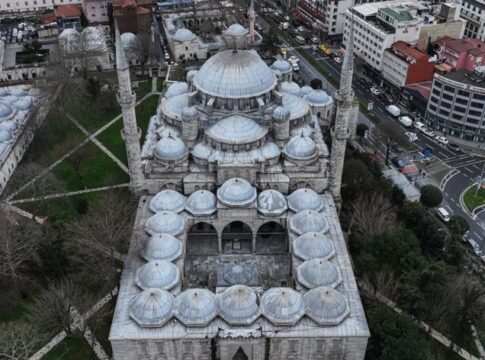

The Şehzade Mosque stands as a defining symbol of early classical Ottoman architecture and marks the first imperial mosque designed by Mimar Sinan after his appointment as chief architect. Commissioned by Suleiman the Magnificent, the mosque was built in memory of his beloved son Şehzade Mehmet, who passed away in 1543 while serving as governor of Manisa.
Located in the Şehzadebaşı neighborhood of Istanbul’s Fatih district, the mosque remains an active place of worship and a major site of interest for historians, architects, and visitors from around the world.
A Monument Born of Loss
In 1543, the sudden death of Prince Şehzade Mehmet at the age of 22 deeply affected Sultan Suleiman. To honor his son’s memory, the sultan commissioned an imperial mosque complex. Construction began the same year and continued until 1548 under the supervision of Mimar Sinan.
READ MORE: BGN Prohibits Plastic Packaging for Ramadan Free Meals
For Sinan, this project was particularly significant. He later described the Şehzade Mosque as his “apprentice work,” a modest characterization considering its remarkable architectural innovation. Despite his own humble description, scholars widely regard the mosque as a foundational step in the evolution of Ottoman imperial architecture.
Architectural Innovation and Design
The Şehzade Mosque introduced a bold and centralized architectural plan. At its core is a large central dome measuring approximately 18.5 meters in diameter. This dome is supported by four massive piers connected by high pointed arches.
What makes the structure distinctive is the use of four semi-domes extending symmetrically from the central dome in four directions. Smaller corner domes complete the roofing system, creating a harmonious and balanced interior space.
This arrangement represents an early exploration of dome-centered architecture that Sinan would later perfect in the Selimiye Mosque in Edirne, considered his architectural masterpiece.
Interestingly, Sinan did not replicate this exact four semi-dome configuration elsewhere in central Istanbul. However, his students adopted and adapted the concept in later imperial projects. The design reappeared in the Yeni Mosque, initiated by Davut Ağa, and in the Sultan Ahmed Mosque, designed by Sedefkar Mehmet Ağa.
The Ottoman Külliye Concept
The Şehzade Mosque is not just a standalone structure; it is part of a classical Ottoman külliye (complex). This integrated urban design reflects the Ottoman understanding of architecture as both spiritual and social infrastructure.
The complex includes:
-
A madrassa (Islamic school)
-
A public kitchen (imaret)
-
A hospice
-
A caravanserai
-
A primary school
-
Tombs and cemetery areas
This mosque-centered complex was carefully organized along dual axes, creating a highly structured and functional layout. The madrassa and caravanserai are positioned toward the rear of the mosque, while the tomb precinct extends across the southern section.
Historical evidence also indicates the presence of Janissary quarters in the surrounding area, underscoring the strategic and social importance of the complex within Ottoman Istanbul.
The Tomb of Şehzade Mehmet
Within the southern cemetery lies the tomb of Şehzade Mehmet. The mausoleum features an octagonal plan crowned by a dome and is one of the most artistically refined elements of the complex.
The exterior is constructed with finely cut stone and marble detailing. Inside, the tomb is decorated with vibrant glazed tiles influenced by Iranian and Central Asian artistic traditions, particularly Timurid aesthetics. These rich decorative elements reflect a style that would later evolve within Ottoman art.
Visitors can still see the wooden sarcophagus cover placed by Sultan Suleiman himself, adding a deeply personal and emotional dimension to the monument.
The cemetery surrounding the tomb also contains the graves of several prominent Ottoman figures, further enhancing the site’s historical significance.
Influence Beyond Istanbul
Although Sinan referred to the mosque as his apprentice work, its architectural concept had a lasting impact. The centralized dome plan supported by multiple piers influenced both imperial and provincial Ottoman mosques.
Over time, similar structural systems appeared in regions beyond Istanbul. Examples include the Mosque of Muhammad Ali in Cairo, the Mehmet Bey Mosque in Tunis, and the Great Mosque of Homs in Syria.
These later structures demonstrate how Sinan’s early experimentation shaped Ottoman and post-Ottoman mosque architecture across different regions.
A Living Monument
Today, the Şehzade Mosque continues to function as a place of worship while attracting architectural scholars and cultural tourists. Over the centuries, the complex has undergone multiple restorations and additions, ensuring its preservation for future generations.
As Sinan’s first imperial commission, the mosque represents more than architectural innovation. It embodies personal grief, imperial ambition, and the beginning of a golden era in Ottoman architectural history.
The Şehzade Mosque remains a powerful reminder that from loss can emerge enduring beauty — a structure that continues to define Istanbul’s skyline and architectural legacy.