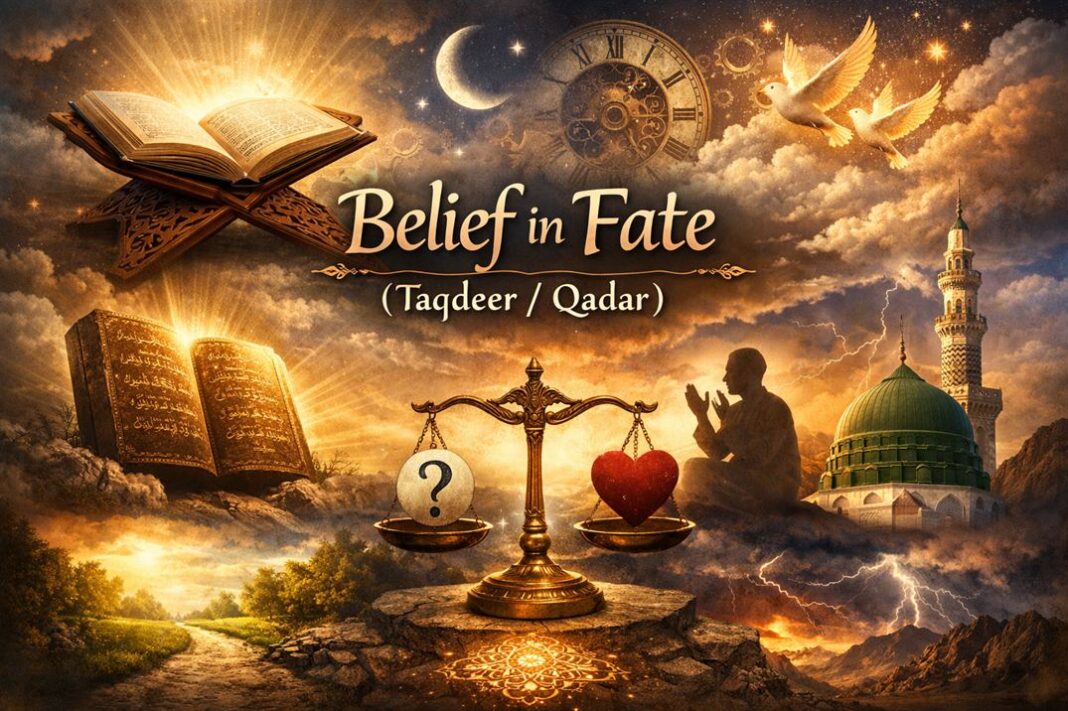

Belief in Fate, known in Islam as Taqdeer or Qadaa and Qadar, is one of the most essential foundations of Islamic faith. Without this belief, a person’s Iman remains incomplete. Islam teaches that life is not random, chaotic, or meaningless. Rather, everything that happens in the universe unfolds according to the perfect knowledge, wisdom, and will of Allah Almighty.
A Muslim believes that every moment of existence—whether joy or hardship, success or failure, health or illness—occurs by the decree of Allah. This belief does not weaken human effort or responsibility; instead, it strengthens patience, humility, trust, and reliance upon Allah.
READ MORE: Belief in the Life after Death
Belief in Qadar gives meaning to suffering, balance to success, and peace to the heart. It protects a believer from arrogance during times of ease and from despair during times of difficulty.
Belief in Qadar as an Article of Faith
Belief in Divine Decree is one of the six articles of faith in Islam. These articles define the core of Islamic belief and are necessary for a person to be considered a true believer.
The Prophet Muhammad ﷺ clearly mentioned belief in Qadar when explaining the meaning of Iman.
Hadith of Jibreel (AS)
Arabic:
الإيمان أن تؤمن بالله وملائكته وكتبه ورسله واليوم الآخر وتؤمن بالقدر خيره وشره
Translation:
“Faith is to believe in Allah, His angels, His books, His messengers, the Last Day, and to believe in Divine Decree (Qadar), both its good and its bad.”
(Sahih Muslim)
This hadith shows that belief in Qadar is not optional. Rejecting it or misunderstanding it can lead to confusion, weak faith, or even deviation from correct Islamic belief.
Meaning of Qadaa and Qadar
The words Qadaa and Qadar are closely related but carry slightly different meanings.
Qadar refers to Allah’s eternal knowledge and precise measurement of all things before they occur. Qadaa refers to the actual execution of what Allah has decreed at its appointed time.
Together, Qadaa and Qadar describe Allah’s complete control over creation, from the planning of events to their realization in the world.
Nothing exists outside this divine system. Nothing occurs independently. Nothing surprises Allah.
Everything Happens by Allah’s Perfect Knowledge
Allah’s knowledge is absolute, eternal, and complete. He knows what has happened, what is happening now, what will happen in the future, and even what could have happened if circumstances were different.
Allah’s knowledge is not like human knowledge. Humans learn gradually, forget easily, and make mistakes. Allah’s knowledge is perfect and timeless.
Qur’an – Surah Al-An‘am (6:59)
Arabic:
وَعِندَهُ مَفَاتِحُ الْغَيْبِ لَا يَعْلَمُهَا إِلَّا هُوَ
Translation:
“And with Him are the keys of the unseen; none knows them except Him.”
Every leaf that falls, every breath that is taken, and every thought that crosses a human mind is known to Allah before it occurs.
Allah Created Everything with Measure
Islam teaches that the universe is not disorderly. Everything has been created with balance, proportion, and purpose.
Qur’an – Surah Al-Qamar (54:49)
Arabic:
إِنَّا كُلَّ شَيْءٍ خَلَقْنَاهُ بِقَدَرٍ
Translation:
“Indeed, We have created all things with precise measure.”
This verse confirms that every event, big or small, follows a divine plan. Nothing is wasted, and nothing is meaningless in the sight of Allah.
The Writing of Destiny (Al-Lawh Al-Mahfooz)
Allah has recorded everything that will happen in a preserved record known as Al-Lawh Al-Mahfooz (The Preserved Tablet).
Long before the creation of the heavens and the earth, Allah had already written the destiny of every creature.
Hadith
Arabic:
كَتَبَ اللَّهُ مَقَادِيرَ الْخَلَائِقِ قَبْلَ أَنْ يَخْلُقَ السَّمَاوَاتِ وَالْأَرْضَ بِخَمْسِينَ أَلْفَ سَنَةٍ
Translation:
“Allah wrote the decrees of all creation fifty thousand years before He created the heavens and the earth.”
(Sahih Muslim)
This writing does not force human actions. Rather, it reflects Allah’s complete knowledge of what humans will freely choose.
Human Free Will in Islam
Islam firmly establishes that human beings possess free will. Allah has given humans intellect, understanding, and the ability to choose between right and wrong.
This free will is the reason humans are held accountable on the Day of Judgment.
Qur’an – Surah Al-Kahf (18:29)
Arabic:
فَمَنْ شَاءَ فَلْيُؤْمِنْ وَمَنْ شَاءَ فَلْيَكْفُرْ
Translation:
“So whoever wills—let him believe; and whoever wills—let him disbelieve.”
Allah allows humans to choose, but He already knows what they will choose. His knowledge does not force their decisions.
Allah’s Will Encompasses All Things
Although humans have free will, nothing can occur without Allah’s permission.
Qur’an – Surah At-Takwir (81:29)
Arabic:
وَمَا تَشَاءُونَ إِلَّا أَنْ يَشَاءَ اللَّهُ رَبُّ الْعَالَمِينَ
Translation:
“And you do not will except that Allah wills—Lord of the worlds.”
This balance between divine will and human choice is a unique feature of Islamic belief.
Allah Is the Creator of Actions
Allah is the Creator of everything, including human actions. However, humans are responsible for their intentions and choices.
Qur’an – Surah As-Saffat (37:96)
Arabic:
وَاللَّهُ خَلَقَكُمْ وَمَا تَعْمَلُونَ
Translation:
“Allah created you and what you do.”
This does not remove accountability. Rather, it shows that human power exists only because Allah allows it to exist.
Wisdom Behind Trials and Hardships
Allah allows hardship for reasons that may not always be clear to humans.
Trials purify sins.
Trials strengthen faith.
Trials reveal sincerity.
Trials raise spiritual ranks.
Qur’an – Surah Al-Baqarah (2:216)
Arabic:
وَعَسَىٰ أَنْ تَكْرَهُوا شَيْئًا وَهُوَ خَيْرٌ لَكُمْ
Translation:
“Perhaps you hate a thing and it is good for you.”
What appears harmful may carry hidden mercy.
Patience and Gratitude in Qadar
A believer responds to Qadar in two ways: patience during hardship and gratitude during ease.
Hadith
Arabic:
عَجَبًا لِأَمْرِ الْمُؤْمِنِ
Translation:
“Amazing is the affair of the believer. If good comes to him, he is grateful, and that is good for him. If hardship comes to him, he is patient, and that is good for him.”
(Sahih Muslim)
Avoiding Despair and Arrogance
Islam forbids despair over losses and arrogance over blessings.
Qur’an – Surah Al-Hadid (57:22–23)
Arabic:
لِكَيْلَا تَأْسَوْا عَلَىٰ مَا فَاتَكُمْ وَلَا تَفْرَحُوا بِمَا آتَاكُمْ
Translation:
“So that you may not grieve over what has escaped you nor boast over what He has given you.”
Taking Means While Trusting Allah
Belief in Qadar does not mean abandoning effort.
The Prophet ﷺ said:
Arabic:
اعْقِلْهَا وَتَوَكَّلْ
Translation:
“Tie your camel and then rely upon Allah.”
(Tirmidhi)
A Muslim plans, works, and strives, while trusting Allah for the outcome.
Can Du‘a Change Destiny?
Yes, du‘a can change conditional destiny.
Hadith
Arabic:
لَا يَرُدُّ الْقَدَرَ إِلَّا الدُّعَاءُ
Translation:
“Nothing repels destiny except supplication.”
(Tirmidhi)
Allah, in His mercy, has allowed du‘a to be a means of change.
Common Misunderstandings About Qadar
Some people wrongly believe they can justify sins using Qadar. Islam rejects this.
Allah commands obedience and forbids sin. Humans choose their actions and will be judged accordingly.
Living With True Belief in Qadar
True belief in Qadar creates peace of mind, emotional stability, and spiritual strength.
A believer understands that Allah is Wise, Just, and Merciful. Even when events seem painful, they are never meaningless.
Conclusion
Belief in Taqdeer teaches Muslims to live with purpose, humility, patience, and trust in Allah.
Whatever Allah decrees is always for the best, even when the wisdom is hidden.
Final Qur’anic Verse
Arabic:
وَتَوَكَّلْ عَلَى اللَّهِ ۚ وَكَفَىٰ بِاللَّهِ وَكِيلًا
Translation:
“And rely upon Allah; and sufficient is Allah as Disposer of affairs.”
(Surah Al-Ahzab 33:3)