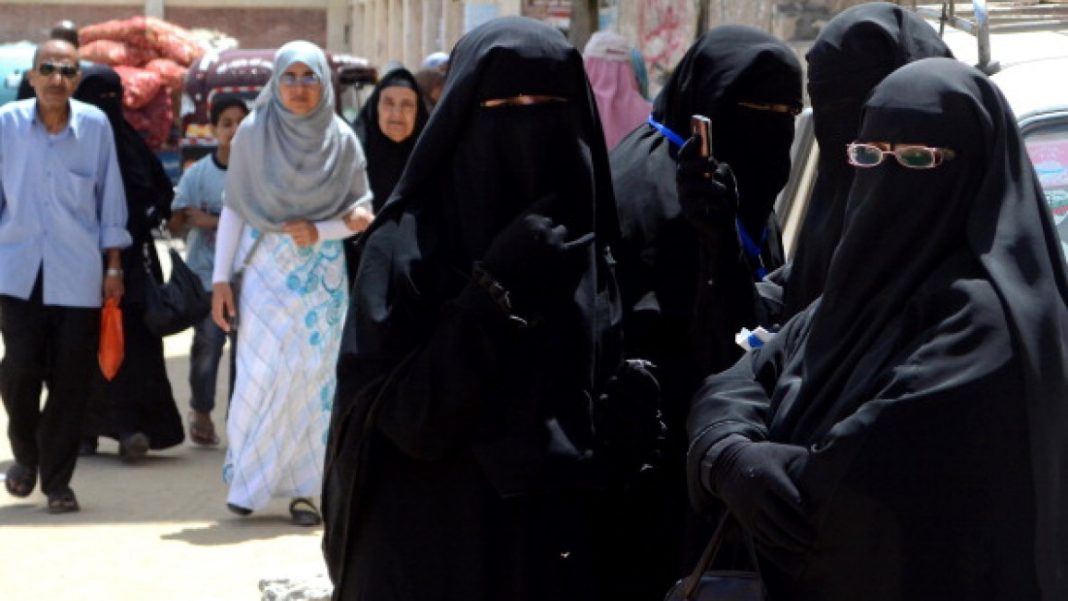

The rather conservative niqab has long been advocated by extremist religious groups and Salafi sheikhs, even though it is known for not being an obligatory dress code by Islam.

The ban of niqab at schools sparked the outrage of conservative Muslims in Egypt. [Getty]
The Egyptian government has banned the niqab (full-face veil) inside public and private schools as of the new academic year due on 30 September, a move that sparked the outrage of extremist Muslims in the North African country.
In a statement released on Monday and cited by local news outlets, education minister RedaHegazy said that female students have an “optional” right whether to cover their hair with Islamic hijab [veil] at school or not but without their faces covered.
Hegazy, meanwhile, allowed the head cover provided that the student is not coerced to put it on and after being approved by the legal guardian, usually the father or the mother, in case of his absence.
“The decision is for the welfare of Egyptian students, limiting any chances of cheating, identity thefts and other possible crimes,” an education ministry source told The New Arab on condition of anonymity.
“You cannot easily identify who the student covering her face is. In the past, irregularities committed by those wearing a face veil couldn’t be spotted on time, such as students replacing others in exams or men disguised as a face-veiled woman inside women-only places,” the source added.
The relatively conservative niqab has long been advocated by extremist religious groups and Salafi sheikhs, even though it is known for not being an obligatory dress code in Islam.
Several Islamic scholars have frequently argued that women must show their faces during prayers and Hajj (holy pilgrimage) as per the teachings of the holy Quran, which further proves their argument that it is an optional outfit.
Egyptian women’s dress code has always been a subject of dispute in Egyptian society over the past few decades.
In 2020, an Egyptian court ruled that it is prohibited among the academic staff at Cairo University.
Months later, the same year, controversial, unveiled TV presenter Radwan El-Sherbini sparked a heated debate by saying that “women who did not wear hijab had the devil inside them”.
Despite its widespread popularity, a BBC Arabic investigation revealed last year that women wearing the hijab have been discriminated against in Egypt.
World
The New Arab Staff
The investigation revealed several high-end establishments across Cairo, Egypt’s capital, refuse entry to women wearing headscarves. The hijab even prevented some women and families from purchasing property in luxury resorts.
The hijab became more common in Egypt at the end of the 1970s and the beginning of the 1980s when many Egyptians migrated to Gulf countries – especially Saudi Arabia – to find work, with some being influenced by the extremist Wahhabi doctrine.
Over the past years, women who do not wear the hijab were often subject to criticism, especially among the lower and middle classes.
Whether hijab is obligatory in Islam or not has been a subject of debate for many years among Islamic scholars and intellectuals.
While some women find themselves compelled to wear it outside their homes due to social pressure, others abide by it out of belief.