
Eid Prayer is a significant festival in Islam, marking the end of Ramadan, the holy month of fasting. One of the most important aspects of Eid celebrations is the Eid prayer, which holds deep spiritual significance for Muslims worldwide.
In this comprehensive guide, we will delve into the details of Eid prayer, including how to perform it, the importance of cleanliness, the step-by-step process, and everything else you need to know to make your Eid prayer meaningful and fulfilling.
1. The Significance of Eid Prayer
Eid prayer, also known as Salat al-Eid, is a special congregational prayer held on the morning of Eid al-Fitr, the festival that follows Ramadan, and Eid al-Adha, the festival of sacrifice. Its significance lies in its role as a communal act of worship and gratitude to Allah. Here’s why Eid prayer is so important:
READ MORE: 5 Most Important Duas in Quran that You Can Recite
It is reported that the Prophet Muhammad (peace be upon him) said: “The first thing we do on the day of Eid is to perform the Eid prayer.” (Sahih al-Bukhari)
-
A Celebration of Gratitude
Eid prayer is a way for Muslims to express gratitude to Allah for the strength and patience they exhibited during Ramadan.
Quran 14:7: “And [remember] when your Lord proclaimed, ‘If you are grateful, I will surely increase your favor; but if you deny, indeed, My punishment is severe.”
It’s a celebration of the spiritual growth achieved through fasting, prayer, and self-reflection during the holy month.
-
Unity and Community
Eid prayer brings the Muslim community together, fostering a sense of unity and solidarity.
It strengthens the bonds of brotherhood and sisterhood among Muslims.
-
A Reminder of Sacrifice
Eid al-Adha prayer, in particular, serves as a reminder of the willingness of Prophet Ibrahim (Abraham) to sacrifice his son, Isma’il (Ishmael), in obedience to Allah’s command.
Muslims commemorate this act of faith by performing the Eid al-Adha prayer.
2. Preparation for Eid Prayer
-
Purification and Cleanliness (Taharah)
Purification through ritual ablution (Wudu) is essential before performing any prayer in Islam, including Eid prayer.
Quran 5:6: “O you who have believed, when you rise to [perform] prayer, wash your faces and your forearms to the elbows and wipe over your heads and wash your feet to the ankles…”
Cleanliness is not just physical but also spiritual; Muslims are encouraged to cleanse their hearts and intentions.
-
Dressing for the Occasion
It is recommended to wear one’s best clothes, symbolizing joy and gratitude, on Eid.
Many Muslims choose to wear new clothes, adhering to the tradition of dressing up for this special day.
The Prophet Muhammad (peace be upon him) encouraged Muslims to adorn themselves for Eid: “When it is the day of Eid, the angels stand at the gate of the mosque and say, ‘O people of prayer! Come to the assembly of your Lord with beautification and good scent.'” (Jami` at-Tirmidhi)
3. How to Perform Eid Prayer
-
Niyyah (Intention)
Begin by making a sincere intention in your heart to perform the Eid prayer. The intention should be solely for the sake of Allah.
-
Timing and Location
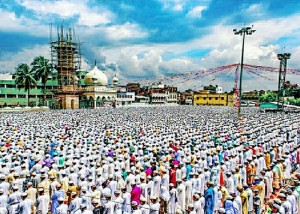
Eid prayer is performed in an open area or a large mosque, preferably a central gathering place.
It is held shortly after sunrise and consists of two units (Rak’ahs).
-
Takbirat al-Ihram
The prayer starts with the Takbirat al-Ihram (the opening “Allahu Akbar” declaration), raising both hands to the ears.
This is followed by the opening supplication, seeking Allah’s guidance and blessings.
-
Recitation of Surah Al-Fatiha and Another Surah
After the Takbir, recite Surah Al-Fatiha and another Surah of your choice in the first Rak’ah.
In the second Rak’ah, recite Surah Al-Fatiha and another Surah or a portion of a Surah.
-
Ruk’ahs, Sujood, and Tashahhud
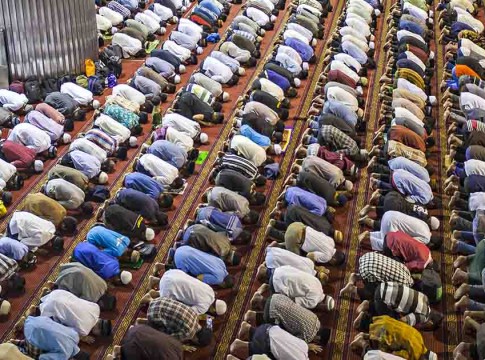
Perform the Ruk’ahs (bowing) and Sujood (prostration) as in regular Salah.
In the second Rak’ah, after the second Sujood, recite the Tashahhud, sending blessings upon the Prophet Muhammad (peace be upon him).
-
Additional Takbirs
After the Tashahhud in the second Rak’ah, raise your hands and recite three additional Takbirs.
Each time you say “Allahu Akbar,” raise your hands to the ears and then place them on your sides.
-
Tasleem (Salutation)
Conclude the prayer by turning your head to the right and saying “As-salamu alaykum wa rahmatullah” to both sides.
4. Post-Prayer Activities and Traditions
-
Giving and Receiving Eid Greetings
After the prayer, Muslims exchange warm greetings of “Eid Mubarak” (Blessed Eid) with family and friends.
This is an opportunity to express love and goodwill to one another.
-
Acts of Charity (Zakat al-Fitr)
Before the Eid prayer, Muslims are encouraged to give Zakat al-Fitr, a form of charity, to those in need.
The Prophet Muhammad (peace be upon him) mandated Zakat al-Fitr on the occasion of Eid: “The fast remains suspended between Heaven and Earth until the Sadaqat al-Fitr are paid.” (Sunan Abi Dawood)
It is obligatory on those who can afford it and ensures that everyone can partake in the festivities.
-
Visiting Family and Friends
Eid is a time for visiting relatives and friends, strengthening bonds, and sharing meals.
Acts of kindness and hospitality are highly encouraged.
Quran 3:103: “And hold firmly to the rope of Allah all together and do not become divided. And remember the favor of Allah upon you – when you were enemies and He brought your hearts together and you became, by His favor, brothers.”
-
Festive Meals
Special Eid dishes are prepared, and families come together to enjoy a feast.
It’s a time to savor traditional cuisines and sweet treats.
The Prophet Muhammad (peace be upon him) mandated Zakat al-Fitr on the occasion of Eid: “The fast remains suspended between Heaven and Earth until the Sadaqat al-Fitr are paid.” (Sunan Abi Dawood)
Conclusion
Eid prayer is a beautiful and spiritually enriching way to celebrate the end of Ramadan and the festival of Eid. Its rituals, from purification to the performance of the prayer itself, hold deep significance for Muslims around the world. Beyond the prayer, Eid is a time for community, charity, and joyous gatherings with loved ones.
By understanding the importance of Eid prayer, preparing for it with cleanliness and sincerity, and following the step-by-step process, you can make the most of this special occasion and ensure it becomes a memorable and spiritually uplifting experience. May your Eid be filled with blessings, peace, and joy. Eid Mubarak!