
September 13, 2023 at 11:59 pm
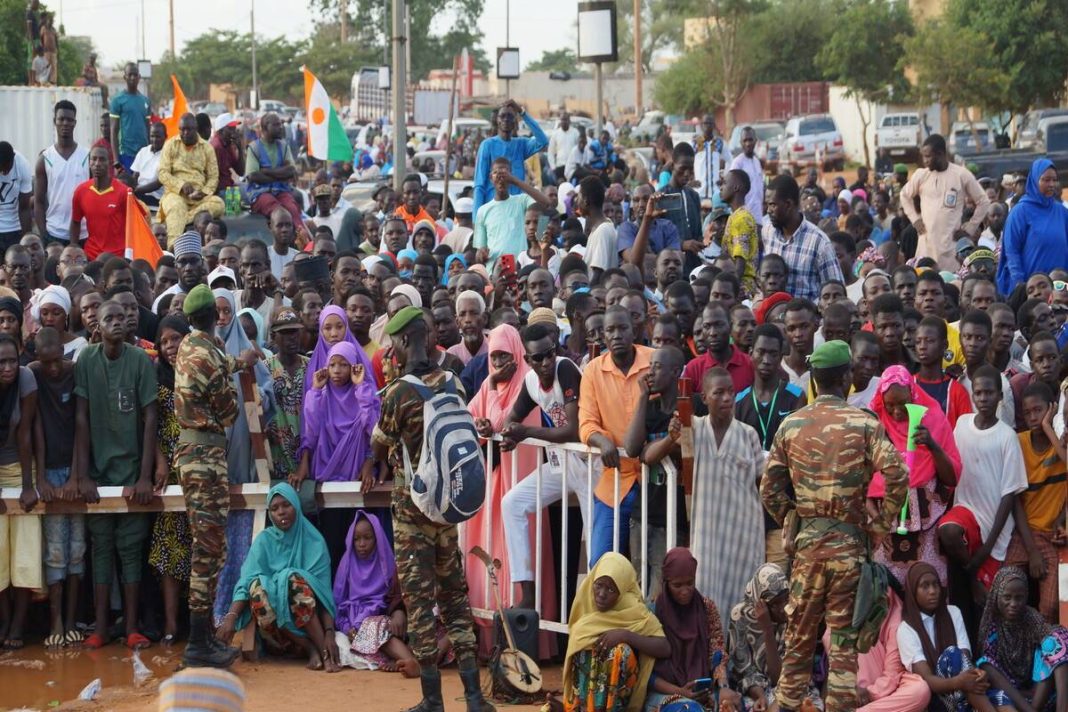
![Thousands of people gather in front of the French military base to hold a demonstration in the capital Niamey demanding the French soldiers to leave the country, on September 03, 2023 [Balima Boureima/Anadolu Agency]](https://i0.wp.com/www.middleeastmonitor.com/wp-content/uploads/2023/09/AA-20230903-32067149-32067142-THOUSANDS_STAGE_PROTEST_IN_NIGER_DEMANDING_FRENCH_SOLDIERS_TO_LEAVE_COUNTRY.jpg?fit=1200%2C800&ssl=1 "Epidemic or revolution: the other side of the West Africa upheaval")
Thousands of people gather in front of the French military base to hold a demonstration in the capital Niamey demanding the French soldiers to leave the country, on September 03, 2023 [Balima Boureima/Anadolu Agency]
What if the “epidemic of coups” in West and Central Africa is not that at all, but a direct outcome of outright revolutionary movements, similar to the anti-colonial movements that liberated most African nations from the yoke of Western colonialism throughout the 20th century?
Whether this is the case or not, we are unlikely to find out anytime soon, simply because the voices of these African nations are largely and deliberately muted.
In order for us to understand the real motives behind the spate of military takeovers in West and Central Africa – eight since 2020 – we are, sadly, compelled to read about it in Western media.
And that is a major part of the problem. Simply put, Western media has failed to convey the deeper social and economic contexts behind the political upheaval in various African regions.
The near-complete control over the narrative, however, is deliberate.
READ: Gabon: Another tough strike for France in Africa
In a relatively comprehensive description of Oligue Nguema, the new leader of Gabon, the BBC website offered nothing of substance in terms of familiarising us with the motives behind the military’s move against the corrupt, long-time leader of Gabon, Ali Bongo.
Of course, the voice of Nguema himself was almost completely absent in the piece.
It is difficult and time-consuming to find a cohesive, non-filtered political discourse emanating from Gabon – or Mali, Burkina Faso or the rest of the African countries undergoing political transitions now.
What we find, instead, is news, information and opinions, almost all filtered through Western news agencies, politicians, academics and ‘experts’. Even those who may appear to speak non-conformist language tend to feed the stereotype, perpetuating the mainstream perception of Africa.
A quick examination of recent articles on West Africa in the French media reveals an obvious truth. The language used in deconstructing the recent upheaval demonstrates that no true awakening is underway among the French intelligentsia, even by those who purportedly speak as part of the country’s mainstream ‘left’.
In an interview, published on 30 August in Le Point, French author and expert in African Studies, Antoine Glaser, blames the French government for failing to see how Africa has ‘gone global’.
The article appeared shortly after the Gabon coup. But Glaser’s ideas are not new. He has made several references in the past to such failure, including an article in L’Opinion early in August.
The gist of his argument is that France has failed to understand the changing political dynamics in and around Africa, and that the once tightly French-controlled African markets have been largely occupied by China, Turkiye and others.
But the subtle message is this: Africa revolves or should always revolve in France’s orbit, and an alternative understanding must be developed by policymakers in Paris to cope with, or catch up to the new, globalised African politics.
The same sense of entitlement was conveyed in Le Figaro.
READ: Africa will not allow France’s exploitation to continue
Isabelle Lasserre, in her article entitled ‘Gabon: la diplomatie française désarçonnée par l’«épidémie» de coups d’État en Afrique’, speaks of “bathtub torture” of French diplomats.
“They barely believe they can get their heads out of the water when a new putsch plunges it back into them, even more brutally,” she writes.
The ‘brutality’ referenced here is not that suffered by African nations in the painful periods of colonialism, post-colonialism and decolonisation, but that of French diplomats.
Lasserre references Macron’s use of the phrase “epidemic of putschs” – “putschs” being another word for ‘coups’ in German.
It was Macron who popularised the term. It makes Africans appear unruly, sick even. French journalists are now blaming their government for failing to diagnose, let alone remedy, the pan-African disease.
No alternative understanding is possible when the problem is coined in such a way, where the blame is squarely on Africans, and the lesser blame – of simply failing to understand – is placed on France and other Western governments.
“In Africa, one coup does not drive out another but adds to the previous one,” Lasserre writes.
In other words, it is an African-induced chaos, and Europe is suffering and shouldering its consequences – ‘a white man’s burden’ of sorts.
Little attention has been paid to the possibility that perhaps African countries are fed up with the old apparatus, that of Western-supported wealthy and violent dictators – and supposed ‘democrats’ – who squander their country’s wealth to remain in power.
Gabon is a very rich country in terms of energy resources, lumber, manganese and iron. But its tiny population of 2.3 million is very poor.
This racket of exploitation has been sustained for decades simply because it served the interests of the local rulers and their multinational partners.
What other means of protests do the people of Gabon – or Mali, or all the rest – have, when mass rallies are violently crushed and the media is tightly controlled? – aside, of course, from military coups.
READ: A strong anti-colonial case against France, with Niger as an example
This does not seem to be the heart of the matter to many in the French media, who are mostly concerned about losing their stronghold in Africa to China, Russia and others.
Instead, some in the media are even flouting the theory that Africans are impressed with the persona of ‘strongmen‘ of non-democratic regimes – a direct reference to Russia and China.
Although the ‘strongman theory’ has long been discounted, or at least lost its appeal in academic circles, it is often applied in its old form and ugly insinuations in Western understanding of Africa, Asia and the Middle East.
It would make no sense for Africans to reject democracy, one that is based on true equality, fair distribution of wealth, ample opportunities, freedom of expression and the press and all the rest. The only explanation, though often communicated indirectly, is that they all suffered from collective malaise, which complicates the supposedly noble mission of Western countries.
In truth, many African nations – as demonstrated by the latest popular military takeovers – deeply resent Western governments for the right reasons: their military interventions, economic exploitation, political meddling and a lingering sense of superiority.
Rarely do we hear such alternative views because we are not meant to. The political discourse emanating from West Africa, although largely inaccessible, speaks of a collective desire for a paradigm shift.
“It is necessary for this fight to go through arms, but also through our values, our behaviour, and the recovery of our economy”, said Ibrahim Traoré, the transitional President of Burkina Faso.
In his speech, late last year, he declared that “the fight for total independence has begun”.
A similar sentiment was conveyed by Assimi Goita, President of the Transition in Mali when he spoke about the need to ‘regain’ the nation’s dignity in the context of ‘colonial domination’.
France’s and other Western countries’ ‘experts’ should fundamentally reconsider their understanding of Africa.
They should also diversify their political lexicon, to include ‘dignity’, ‘values’, ‘liberation’ and ‘total independence,’ because, clearly, the language of ‘epidemic of coups’ and other self-serving, convenient phraseology has completely failed.
READ: Losing Niger is one of the toughest strikes for France in Africa
source
Epidemic or revolution: the other side of the West Africa upheaval