
From Revolutionary Hopes to Political Isolation
Over a decade has passed since the ousting of Muammar Gaddafi, yet the Libyan chapter of the Muslim Brotherhood finds itself increasingly sidelined. Once considered a key player in shaping the country’s post-Gaddafi political landscape, the Brotherhood has since experienced a sharp decline in influence — electorally, politically, and socially.
Historical Roots: A Movement Born in Exile
The Brotherhood’s journey in Libya began in the late 1940s, when members fleeing persecution in Egypt sought asylum in the eastern regions of the country. Operating in secrecy during the Gaddafi years, the group remained largely underground, relying on international networks for survival and limited ideological dissemination.
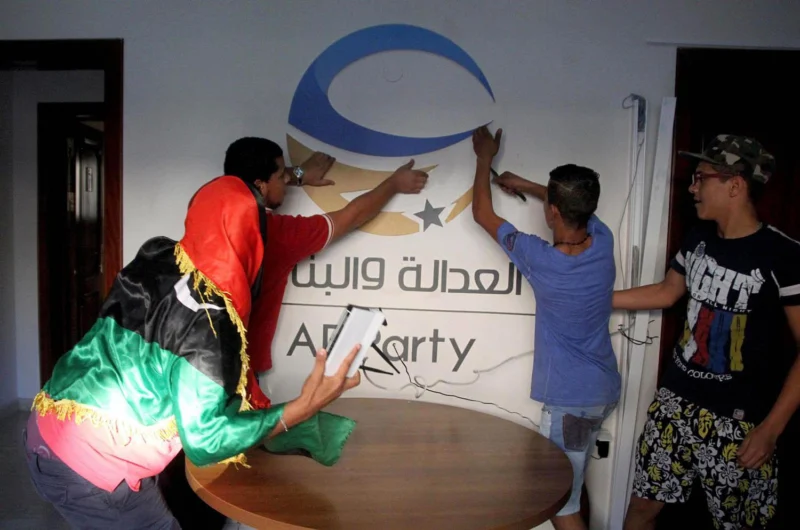
The fall of Gaddafi in 2011 opened a window of opportunity. By early 2012, the Brotherhood had formed a political arm — the Justice and Construction Party (JCP) — claiming to separate its religious identity from political activities. However, critics pointed out that its internal leadership and goals closely mirrored those of its Egyptian counterpart, making the distinction largely cosmetic.
Despite losing to the secular-leaning National Forces Alliance in the 2012 elections, the JCP found a foothold in the General National Congress (GNC), thanks to allied independent candidates. This placed the Brotherhood at the heart of Libya’s volatile transition phase.
The Backlash Begins: Decline in Popularity and Legitimacy
The Brotherhood’s momentum did not last long. In the 2014 elections, the JCP suffered a heavy blow, capturing only a fraction of the seats. Rather than accepting the electoral outcome, factions connected to the Brotherhood supported Operation Libya Dawn — a military offensive that seized control of Tripoli and triggered a second civil war.
This escalation further fractured the nation, creating rival governments in the east and west and plunging Libya into a prolonged state of unrest. The Brotherhood’s involvement in the conflict cost it both political capital and public trust. Many Libyans began viewing the group not as a unifying force but as yet another faction chasing power at the expense of national unity.
Losing Ground: Electoral Defeats and Waning Grassroots Appeal
Subsequent elections further underscored the Brotherhood’s diminishing appeal. Even in historically sympathetic areas like Misrata, Derna, and Abu Salim, its candidates failed to gain traction. The message from voters was clear: the public had grown weary of ideological politics and promises that never materialized.
Compounding the Brotherhood’s struggles was its lack of grassroots infrastructure. Unlike Islamist movements in Tunisia or Egypt, Libya’s Brotherhood failed to build robust educational or charitable wings that could embed it within local communities. This limited its reach and credibility at the social level.
Internal Rifts and Regional Isolation
By 2020, cracks within the movement became increasingly visible. In major cities such as Misrata and Zawiya, mass resignations signaled disillusionment from within. Former members voiced concerns about the organization’s lack of internal reform and rigid leadership structure.
Externally, the regional climate had also shifted. The fall of the Brotherhood in Egypt, coupled with a changing stance from international allies, left the Libyan branch politically adrift. Once shielded by a broader Islamist resurgence in the region, it now faced mounting isolation.
Attempting a Rebrand: Revival and Renewal?
In May 2021, in an apparent attempt to reset its image, the Brotherhood announced its transformation into a new entity: the “Revival and Renewal Association.” Presented as a civil society organization focused on development and national harmony, the move aimed to distance itself from its past affiliations.
However, skepticism quickly emerged. The group retained its original insignia, messaging tone, and religious language, suggesting the change was more about optics than substance. The announcement, posted on the Brotherhood’s verified social media pages, was laced with Quranic references and ideological phrasing reminiscent of its traditional rhetoric.
Analysts argue that this rebranding reflects a regional pattern. Faced with eroding support, Islamist groups often pivot to softer language and civil engagement narratives — all while preserving their core ideological frameworks.
More of the Same? Or a Genuine Reset?
Despite new slogans and public statements, critics remain unconvinced that the Brotherhood’s transformation is more than a tactical retreat. The movement’s emphasis on terms like “Islamic identity,” “revival,” and “principles” continues to suggest an enduring commitment to political Islam, albeit repackaged for a hostile political climate.
The challenge the Brotherhood now faces is twofold: regaining public trust and proving that its role in Libya’s future can be constructive rather than divisive.
Conclusion: A Movement in Retreat
More than ten years since Libya’s revolution, the Muslim Brotherhood’s influence has been significantly diminished. Its political vehicle, the Justice and Construction Party, no longer holds sway. Its support base has withered. And while it has attempted to reinvent itself, the effort appears more like a strategic survival tactic than a true ideological transformation.
For many Libyans, the Brotherhood represents a chapter marked by internal conflict, political opportunism, and unmet promises. Whether operating as a political party or a civil association, it must do more than rename itself — it must demonstrate a genuine commitment to pluralism, democracy, and national healing.
Until then, the Brotherhood’s presence in Libya will likely remain a symbol of what could have been — and what, ultimately, was not achieved.