
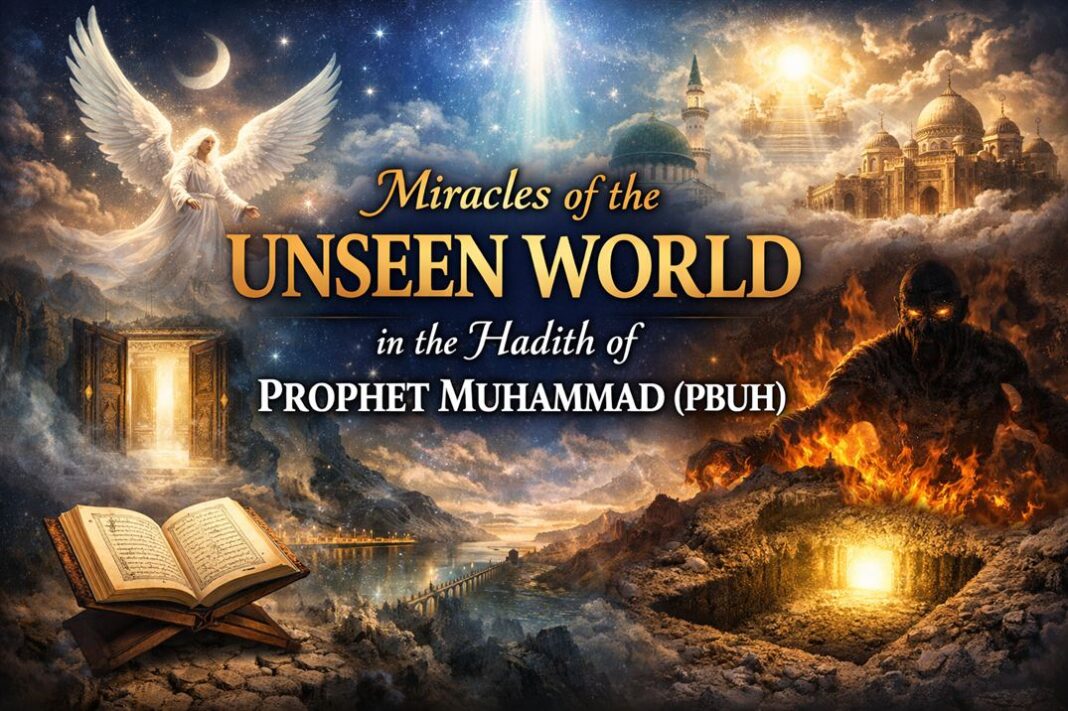


Islam teaches that human perception is confined to the realm of the visible — the tangible world of matter and form. Beyond this world lies the “Unseen” (Ghayb): realities that cannot be observed through ordinary senses. This Unseen world contains divine knowledge, angels, jinn, sacred realms, the events of the Last Day, and numerous phenomena that only Allah knows fully. However, through the revelation of the Qur’an and the authenticated hadiths of the Prophet Muhammad (peace and blessings be upon him), humanity gains glimpses of this hidden dimension.
The Qur’an declares that Allah alone has complete knowledge of the Unseen:
“Say: ‘None in the heavens and earth knows the unseen except Allah…’” (Qur’an 27:65)
Despite this exclusive knowledge, Allah, in His wisdom and mercy, taught aspects of the Unseen through His final Messenger, Prophet Muhammad (PBUH). These teachings are not mere stories — they provide guidance, strengthen faith (iman), illuminate spiritual realities, and remind believers of the greater realities beyond what humans ordinarily perceive.
READ MORE: Is Prophet Muhammad ﷺ Mentioned in the Bible? Hidden Biblical Prophecies Revealed
In this article, we will explore the miracles of the unseen world as revealed in the authentic hadith literature — examining angels, jinn, the hidden aspects of existence, life after death, events of the Last Day, and extraordinary knowledge granted by Allah to His Messenger.
1. The Unseen World in Islam: An Overview
In Arabic, the term Ghayb (الْغَيْب) refers to what is hidden — that which cannot be accessed or verified through human senses, rational deduction, or empirical investigation.
1.1 The Nature of the Unseen (Ghayb)
The Unseen encompasses:
-
Allah’s knowledge of what is hidden (e.g., the future, divine decrees)
-
The world of angels (mala’ika)
-
The realm of jinn (jinniyyah)
-
Records of deeds (al-Lauh al-Mahfuz)
-
Events of the Day of Judgment
-
Realities of heaven (Jannah) and hell (Jahannam)
-
Matters beyond human comprehension
The Qur’an affirms:
“…With Him are the keys of the unseen; none knows them except Him.” (Qur’an 6:59)
1.2 Revelation as the Source of Unseen Knowledge
Although humans cannot verify the Unseen through senses, Allah revealed portions of it to humanity through:
-
The Qur’an
-
The authentic Hadiths of Prophet Muhammad (PBUH)
Thus, the miracle of the Unseen lies not in physical revelation to the senses, but in the transmission of divine knowledge to guide humanity.
2. Angels: Beings of the Unseen
One of the most striking manifestations of the unseen world is the reality of angels (mala’ika). Muslims believe angels are created from light, carry out Allah’s commands, and exist beyond human perception.
2.1 Description and Roles of Angels
The Qur’an mentions angels in multiple verses:
“…They exalt Him night and day, and never slacken.” (Qur’an 21:20)
According to hadith:
-
Angels record human deeds — good and bad.
-
Archangel Jibreel (Gabriel) brought revelation to the Prophets.
-
Angels descend to answer supplications.
-
Angel of death (Malak al-Mawt) extracts souls at the appointed time.
2.2 Angels Surrounding the Prophet (PBUH)
In Sahih Muslim, the Prophet (PBUH) described:
“Every night when the last third of the night remains, Allah descends to the lowest heaven and says: ‘Who is calling upon Me that I may answer him? Who is asking of Me that I may give him? Who is seeking My forgiveness that I may forgive him?’”
— Sahih Muslim
This revealing hadith affirms the unseen reality that angels accompany divine decrees, strengthen supplication, and interact with creation in ways invisible to most humans.
2.3 The Miraculous Nature of Angels
Angels are advanced beings with extraordinary capacities:
-
They can appear in human form (e.g., Angel Jibreel appeared as a man to the Prophet’s Companions).
-
Thousands of angels attend in worship around the Throne of Allah.
-
Angels bear witness to every act of faith and supplication.
These are unseen realities affirmed by authentic hadiths that surpass normal human understanding of existence.
3. The Reality of Jinn
Jinn are an unseen creation from smokeless fire (min nar), mentioned by Allah in the Qur’an:
“…And I (Allah) created the jinn before from a smokeless flame of fire.” (Qur’an 15:27)
3.1 Jinn as a Distinct Creation
Unlike angels, jinn possess free will — they can choose belief or disbelief. Some, like humans, will be rewarded or punished on the Day of Judgment.
3.2 Witness of Jinn to the Prophet (PBUH)
A significant hadith in Sahih Muslim recounts:
A group of jinn listened to the Qur’an recited by the Prophet (PBUH) and embraced Islam.
— Sahih Muslim
This remarkable event underscores that jinn do interact with the visible world, although rarely perceived, confirming their unseen presence.
3.3 Realities and Misconceptions
Islam teaches that:
-
Not all jinn are evil — some believe and obey Allah.
-
Others are rebellious, such as Iblis (Satan).
-
Jinn have communities, families, and lifespans unseen to humans.
4. Divine Knowledge Granted to the Prophet (PBUH)
While Allah is the only Knower of the Unseen, He revealed selective aspects of the Unseen to His Messenger.
4.1 Revelation vs. True Sight
Prophets receive revelation from Allah — not merely human insight. In hadith:
“…If I were to speak about everything unseen, I would have spoken even about what is in your homes…”
— Sahih Muslim
Here, the Prophet (PBUH) clarifies that while some unseen knowledge was granted to him, it was limited by divine wisdom and decree.
4.2 Miraculous Knowledge of Future Events
There are many reported narrations where the Prophet (PBUH) knew events before their occurrence — such as the signs of the Last Day. These reports are authentic and demonstrate his connection to divine revelation, not personal clairvoyance.
5. The Unseen and the Events of the Last Day
One of the most compelling aspects of the unseen world involves eschatology — the study of the Last Day (Yawm al-Qiyamah).
5.1 Signs of the Last Day in Hadith
Many authentic hadiths describe:
-
The appearance of the Mahdi.
-
The descent of Prophet ‘Isa (Jesus).
-
The rise of the Dajjal (the false messiah).
-
Natural and supernatural phenomena preceding the end of times.
These events are part of the unseen future — known fully only to Allah — yet revealed through revelation to guide humanity in preparedness.
5.2 Lessons from Eschatological Hadith
These narrations:
-
Strengthen awareness of mortality.
-
Encourage righteous living.
-
Remind believers that this life is temporary.
They also affirm that temporal existence intersects with spiritual realities beyond human observation.
6. The Grave and the Unseen Realities of the Afterlife
Islamic teachings provide vivid descriptions of what happens after death — another dimension of the unseen.
6.1 The Questioning in the Grave
Authentic hadiths recount that after burial:
-
Two angels, Munkar and Nakir, visit the deceased.
-
They question the soul about faith and deeds.
This unseen event occurs in the grave — a realm invisible to living humans.
6.2 Comfort and Punishment in the Grave
The Prophet (PBUH) explained:
Believers experience comfort and light in their graves, while disbelievers and sinners face constriction and punishment.
— Reported in Sahih Muslim
These realities are unseen, yet affirmed through revelation.
7. Jannah and Jahannam — Realities of the Unseen World
The Qur’an and authentic hadiths describe Paradise and Hellfire — both unseen worlds that will become manifest on the Day of Judgment.

7.1 Description of Paradise
The Prophet (PBUH) described:
-
Rivers beneath gardens
-
Eternal delights without hardship
-
Companions of beauty
-
Peace and satisfaction from the Divine
While these descriptions use metaphorical imagery understandable to humans, the actual realities are beyond sensory comprehension.
7.2 Description of Hellfire
Likewise, Hell is described with:
-
Blazing fire
-
Chains and iron collars
-
Torment for disbelievers and evildoers
These unseen realities serve as warnings and reminders for moral accountability.
8. Dreams as Intersections with the Unseen
Islam recognizes dreams as one avenue where unseen matters influence human perception.
8.1 True Dreams from Allah
Prophetic tradition teaches:
-
True dreams can be glad tidings or warnings.
-
Dreams may reflect spiritual realities, angelic messages, or divine guidance.
8.2 Distinguishing Between Types of Dreams
Islam classifies dreams into:
-
Dreams from Allah
-
Dreams from one’s self
-
Dreams from Shaytan
This classification demonstrates that unseen entities and forces can influence the dream realm.
9. Miracles Confirming the Unseen World
9.1 Isra and Mi’raj – A Journey Beyond the Physical
One of the greatest miracles in hadith literature is the Isra’ and Mi’raj — the night journey and ascension of the Prophet (PBUH):
-
From Mecca to Jerusalem
-
From the earth to the heavens
-
Encountering angels, divine signs, and ultimate proximity to Allah
This event transcends physical limits — affirming realms that ordinary senses cannot access.
9.2 Multiplication of Knowledge and Events
Many companions witnessed events that could not be explained by ordinary means yet were verified through testimony — such as:
READ MORE: Role of Prophet in Islam: Guidance, Mercy, and Leadership for Humanity
-
Prophetic foretelling of future events
-
Unseen phenomena observed by companions
10. Purpose of Revealing the Unseen
10.1 Strengthening Faith
The unseen world manifests Allah’s majesty, power, and complete sovereignty.
10.2 Moral Guidance
Belief in the unseen carries direct moral impact:
“Those who believe in the Unseen…” — Qur’an 2:3
Belief in what cannot be seen generates accountability and hope.
10.3 Reminder of Human Limitations
Humans are reminded of their limited perception and the need to submit to divine wisdom revealed through the Prophet (PBUH).
Conclusion
The miracles of the unseen world — as revealed in the authentic hadiths of Prophet Muhammad (PBUH) — are not abstract mythology but purposeful divine guidance. They:
-
Illuminate unseen realities beyond normal human experience.
-
Strengthen the believer’s iman (faith).
-
Provide moral direction and spiritual awareness.
-
Reveal divine knowledge granted by Allah in measured and wise proportions.
Islamic teachings emphasize that although humans cannot fully perceive the unseen, belief in it is foundational (iman bil-ghayb) and affirmed in both Qur’an and Sunnah.
As believers, exploring these realities not only increases our spiritual depth but reminds us that this temporary world is connected to vast, enduring dimensions that our souls will one day journey into — under the judgment and mercy of Allah, the Most Wise, the All-Knowing.
May Allah increase us in knowledge of what is unseen, and make our faith firm in all that He revealed. Ameen.