
For many people across the world, the name Prophet Muhammad evokes strong emotions—curiosity, reverence, confusion, admiration, or even fear. Unfortunately, much of what people think they know about him is shaped not by authentic history, but by media narratives, political agendas, selective quotations, and inherited prejudices.
This second part of our series addresses one of the most urgent questions of our time:
What do people get wrong about Prophet Muhammad—and what is the reality?
Understanding this distinction is not merely an academic exercise. It directly affects:
How Islam is perceived globally
How Muslims are treated in society
How interfaith dialogue is conducted
How history itself is remembered or distorted
Let us now examine the most common misconceptions, one by one, and compare them with documented historical reality.
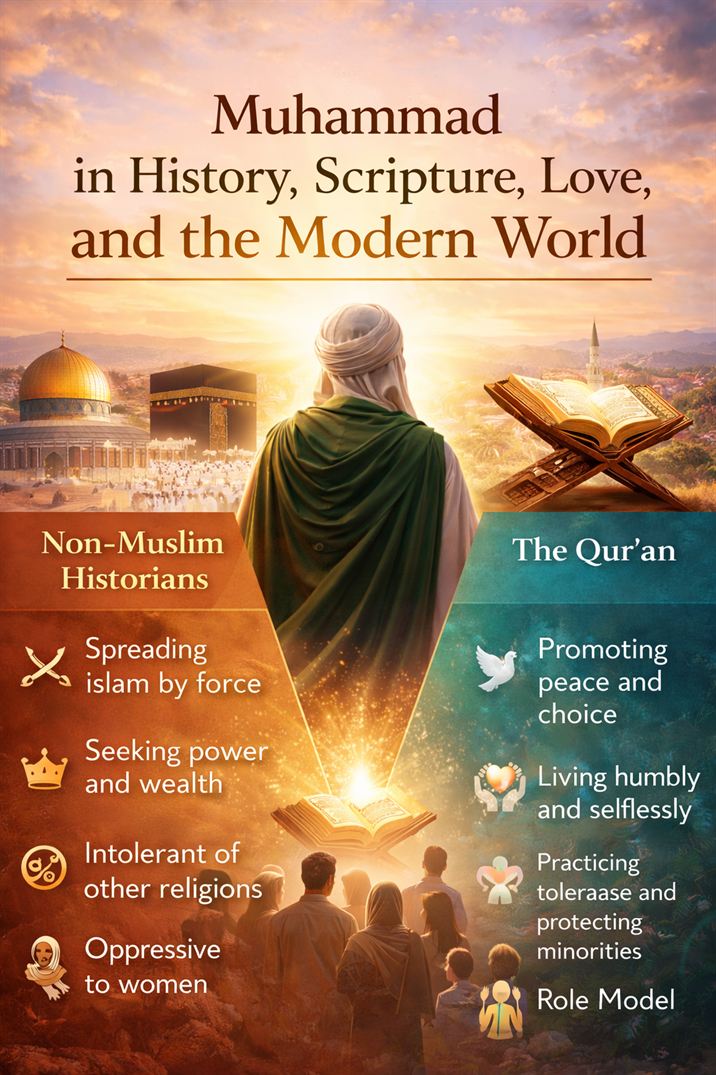
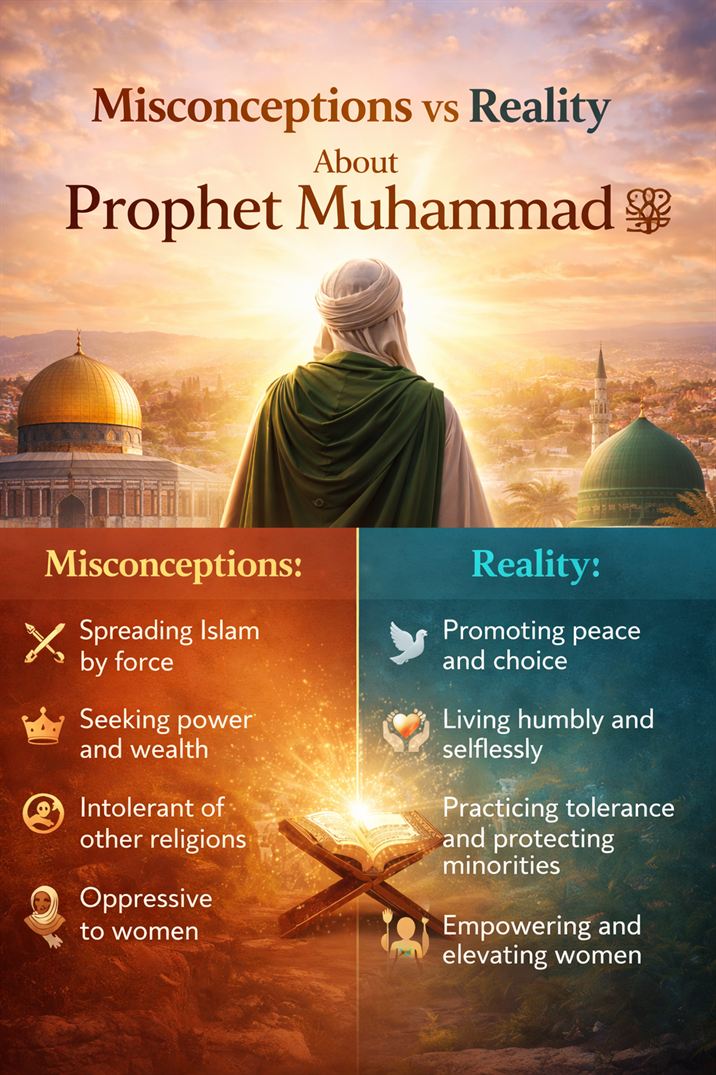
Misconception 1: “Prophet Muhammad Spread Islam by the Sword”
The Claim
One of the most repeated accusations is that Islam was spread through violence and forced conversion, and that Prophet Muhammad used warfare as his primary tool.
READ MORE: Is Prophet Muhammad ﷺ Mentioned in the Bible? Hidden Biblical Prophecies Revealed
The Reality
This claim collapses under historical scrutiny.
For the first 13 years of his mission in Makkah, Prophet Muhammad and his followers:
Were persecuted
Were tortured
Were socially and economically boycotted
Were forbidden from fighting back
Despite extreme oppression, no armed resistance was permitted.
The Qur’an clearly states:
“There is no compulsion in religion.”
When military conflict eventually occurred, it was:
Defensive, not aggressive
Governed by strict ethical rules
Focused on survival, not domination
Even during war, Prophet Muhammad prohibited:
Harm to civilians
Killing women, children, monks, or the elderly
Destruction of crops and places of worship
If Islam had spread by force, it would not have survived after Muslim political power declined. Yet today, Islam continues to grow—primarily through belief, conviction, and personal choice, not coercion.
Misconception 2: “Muhammad Wanted Power, Wealth, and Authority”
The Claim
Some argue that Muhammad invented prophethood to gain control over people, establish political dominance, or secure personal wealth.
The Reality
This claim is contradicted by his entire life trajectory.
Before prophethood:
He was respected
He was trusted
He lived comfortably
After declaring his message:
He was boycotted
He was attacked
He lost social standing
He lived in poverty
The Quraysh leaders of Makkah even offered him:
Kingship
Wealth
Marriage alliances
His response was unequivocal:
“If they placed the sun in my right hand and the moon in my left, I would not abandon this mission.”
When he later became a leader in Madinah, he:
Lived in a modest home
Repaired his own clothes
Often went hungry
Died without leaving wealth behind
This is not the profile of a power-hungry opportunist.
Misconception 3: “Prophet Muhammad Was Intolerant of Other Religions”
The Claim
Critics often portray Prophet Muhammad as hostile toward Jews, Christians, and non-Muslims.
The Reality
Historical records show the opposite.
READ MORE: Example Of Prophet In Islam: The Ideal Model for Humanity
In Madinah, Prophet Muhammad established a pluralistic society through the Constitution of Madinah, which:
Recognized Jews as part of the political community
Guaranteed religious freedom
Protected life and property
Ensured justice regardless of faith
He hosted Christian delegations in his mosque and allowed them to pray according to their tradition.
He said:
“Whoever harms a non-Muslim under Muslim protection has harmed me.”
Religious coexistence under his leadership was not theoretical—it was practiced.
Misconception 4: “Muhammad Promoted Violence and Extremism”
The Claim
Modern extremist groups often misuse Islamic texts and falsely associate their actions with Prophet Muhammad.
The Reality
Extremism violates the explicit teachings of Prophet Muhammad.
He condemned:
Vigilantism
Injustice
Killing innocents
Fanaticism
He warned against extremism in religion, stating that excessiveness leads to destruction.
Groups that commit violence in his name violate his teachings, not represent them.
READ MORE: Master the Islamic Prayer Process with Step-by-Step Guidance
Holding Prophet Muhammad responsible for extremists is like blaming Jesus for the Crusades or Moses for political violence.
Misconception 5: “Muhammad Was Harsh and Cruel”
The Claim
Some narratives depict Prophet Muhammad as stern, unforgiving, or emotionally distant.
The Reality
His life is filled with examples of compassion, forgiveness, and emotional intelligence.
He:
Forgave those who attempted to assassinate him
Showed patience to those who insulted him
Cared deeply for the poor and sick
Wept for suffering humanity
At the conquest of Makkah—when revenge was expected—he declared a general amnesty.
Few moments in history better illustrate moral greatness.
Misconception 6: “Muhammad Oppressed Women”
The Claim
This is one of the most emotionally charged accusations in modern discourse.
The Reality
Prophet Muhammad elevated women in a society that previously:
Buried baby girls alive
Treated women as property
Denied women inheritance
Under his teachings:
Women gained inheritance rights
Marriage required consent
Education was encouraged
Spiritual equality was affirmed
He said:
“The best of you are the best to their families.”
His personal conduct toward women reflected respect, kindness, and partnership—not domination.
Misconception 7: “Muslims Worship Muhammad”
The Claim
Some assume that Muhammad holds a divine status in Islam.
The Reality
Islam strictly rejects the worship of any human being.
Muslims:
Worship God alone
Consider Muhammad a servant and messenger
Believe he had no divine powers
Even excessive praise of Muhammad is discouraged if it risks elevating him beyond human status.
This strict monotheism is foundational to Islam.
Misconception 8: “Muhammad Is Only Relevant to Muslims”
The Claim
Some believe Prophet Muhammad’s relevance is limited to religious rituals or Muslim communities.
The Reality
His legacy extends far beyond religion.
He influenced:
Legal systems
Social justice concepts
Human rights discourse
Ethical leadership models
Historians—Muslim and non-Muslim alike—have recognized his impact on world civilization.
Understanding him is essential to understanding global history.
Why These Misconceptions Persist
Misconceptions about Prophet Muhammad persist due to:
Selective media coverage
Political exploitation of fear
Lack of education
Cultural bias
Absence of direct engagement with primary sources
Ignorance, when repeated often enough, becomes assumed truth.
The Cost of Misunderstanding Muhammad
When Prophet Muhammad is misunderstood:
Muslims are demonized
Faith is reduced to caricature
Dialogue turns into hostility
Peace becomes harder to achieve
Correcting misconceptions is not about winning arguments—it is about restoring human dignity and historical honesty.
Reality in One Sentence
If all misconceptions were stripped away, Prophet Muhammad would be seen as:
A truthful man who called humanity to worship One God, live morally, act justly, and show mercy to all.
Final Reflection: Truth Demands Effort
Knowing the truth about Prophet Muhammad requires:
Reading, not reacting
Listening, not assuming
Context, not slogans
History deserves better than distortion.
Faith deserves better than propaganda.
Humanity deserves better than inherited hatred.