
Muhammad in History – Few individuals in human history have been examined from as many angles as Prophet Muhammad. He has been praised and criticized, loved and misunderstood, followed by billions and written about by scholars across civilizations. Yet, despite this vast attention, his true stature often remains obscured.
This part of our series explores four essential dimensions that help answer a profound question:
Why does Prophet Muhammad continue to matter—historically, spiritually, emotionally, and practically—more than fourteen centuries after his death?
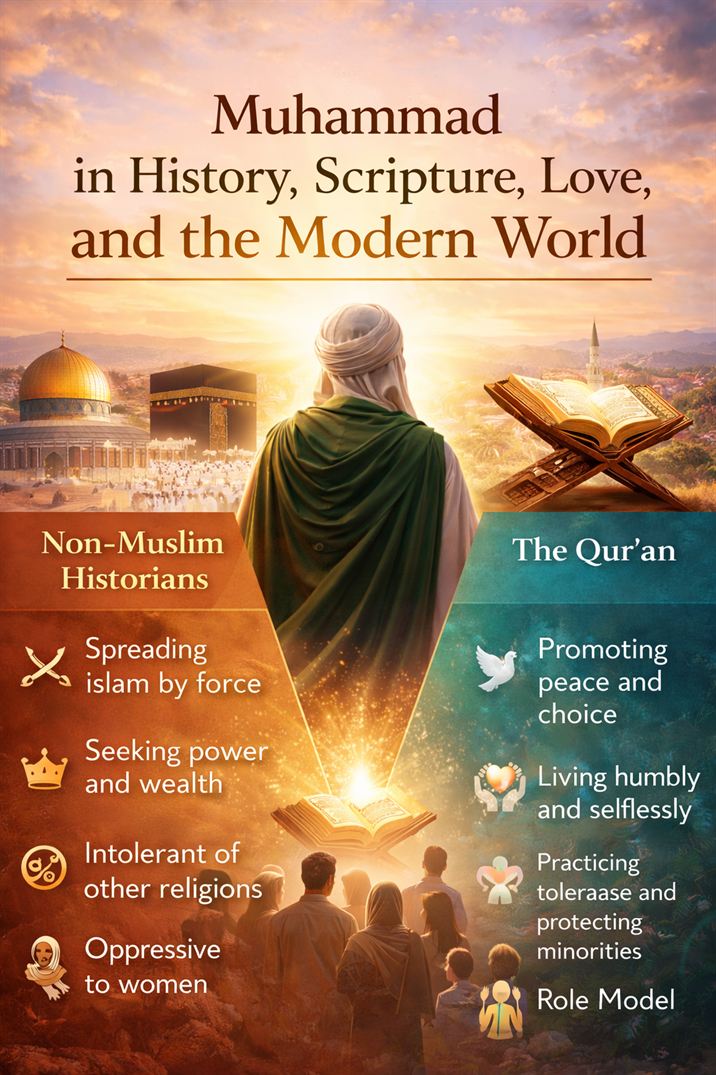
1. Muhammad in the Eyes of Non-Muslim Historians
One of the strongest arguments for the authenticity of Prophet Muhammad’s character and impact comes not from Muslim sources, but from non-Muslim historians, philosophers, and intellectuals who studied him objectively.
A Man Who Changed the Course of History
Western historians widely agree on one fact: Muhammad reshaped the world.
READ MORE: Example Of Prophet In Islam: The Ideal Model for Humanity
Unlike other major historical figures who inherited power, armies, or institutions, Muhammad began as:
An orphan
A merchant
A man without political authority
Yet within 23 years, he transformed:
Religious belief
Social ethics
Legal frameworks
Political organization
This transformation occurred without modern technology, mass media, or centralized state power.
Recognition Beyond Belief
Many non-Muslim scholars emphasize that Muhammad’s success cannot be explained merely by circumstance or force. His leadership combined:
Moral conviction
Strategic wisdom
Emotional intelligence
Social reform
Some historians describe him as:
One of the greatest legislators in history
A rare fusion of spiritual and temporal leadership
A reformer who uplifted entire societies
Importantly, these assessments are not theological endorsements—they are historical conclusions.
Why This Matters
When individuals who do not share a faith still acknowledge the greatness of its central figure, it strengthens the case that:
Muhammad’s impact is real, not mythological
His achievements are measurable and historical
His legacy transcends religious boundaries
2. What the Qur’an Says About Muhammad (ﷺ)
To understand Muhammad fully, one must understand how the Qur’an itself presents him.
READ MORE: Is Prophet Muhammad ﷺ Mentioned in the Bible? Hidden Biblical Prophecies Revealed
The Qur’an does not portray Muhammad as a divine being, nor does it glorify him excessively. Instead, it presents a balanced, disciplined, and deeply human image.
A Servant, Not a Deity
The Qur’an repeatedly emphasizes that Muhammad is:
A servant of God
A messenger
A human being
He is corrected in certain moments, reminded of patience, and guided toward mercy. This self-correcting nature of the Qur’an is significant—it does not read like a book written to glorify its own author.
A Moral Exemplar
The Qur’an describes Muhammad as:
A mercy to all worlds
A model of excellent character
Gentle with believers
Concerned for humanity
His role is not to dominate, but to convey guidance and embody moral excellence.
Why This Portrayal Is Unique
Unlike other religious texts that elevate founders into divine or semi-divine status, the Qur’an:
Keeps Muhammad human
Holds him morally accountable
Grounds his authority in character, not lineage
This balance makes his example accessible and relatable.
3. Why Muslims Love Muhammad So Deeply
For Muslims, love for Prophet Muhammad is not emotional exaggeration or blind devotion—it is rooted in gratitude, connection, and lived experience.
He Is Not a Distant Figure
Muslims do not see Muhammad as a remote historical personality. They see him as:
A guide in daily life
A source of moral clarity
A companion in hardship
His words shape how Muslims:
Pray
Speak
Eat
Marry
Resolve conflict
Love Rooted in Sacrifice
Muslims love Muhammad because he:
Endured hardship so others could find guidance
Lived simply despite access to power
Forgave when revenge was justified
Cared deeply for the weak
His life was not one of luxury—it was one of service.
Love Without Worship
Importantly, this love never crosses into worship. Muslims are taught to:
Love Muhammad
Follow Muhammad
Defend his dignity
But worship belongs to God alone.
This disciplined love preserves both reverence and monotheism.
4. Muhammad as a Role Model for the Modern World
In an age marked by moral confusion, leadership crises, and social fragmentation, Prophet Muhammad’s life offers practical guidance, not abstract ideals.

Leadership with Accountability
Muhammad demonstrated leadership that was:
Transparent
Consultative
Humble
He lived among his people, listened to criticism, and accepted correction. Modern leadership—often disconnected from the governed—can learn deeply from this model.
Justice Without Oppression
He established justice that:
Protected minorities
Held leaders accountable
Applied equally to all
He rejected favoritism and nepotism, emphasizing that moral law applies universally.
Family and Emotional Intelligence
In a time when emotional intelligence is finally being recognized as essential, Muhammad’s conduct stands out:
He expressed affection openly
He acknowledged grief and vulnerability
He treated family life as sacred
This challenges toxic models of masculinity and authority.
Ethics in Conflict
Even during war, Muhammad:
Restricted violence
Prioritized peace
Honored treaties
In a world struggling with ethical warfare and civilian harm, this framework is profoundly relevant.
Why These Four Perspectives Matter Together
When viewed together:
History confirms Muhammad’s impact
The Qur’an defines his mission
Muslim love explains his living legacy
Modern relevance proves his timelessness
No single lens is sufficient on its own. Together, they present a complete and coherent picture.
Final Reflection: Beyond Slogans and Stereotypes
Prophet Muhammad cannot be understood through headlines, caricatures, or selective quotations.
He must be understood through:
History
Scripture
Character
Consequences
To know Muhammad is not merely to know a man—it is to understand a worldview that shaped civilizations and continues to guide hearts.