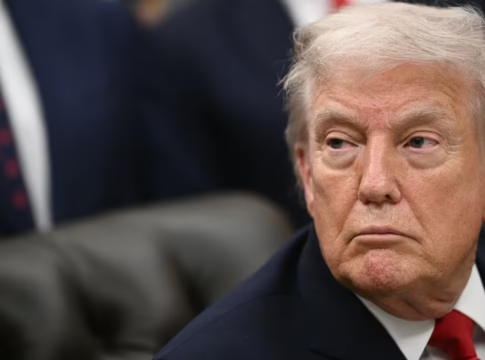

US President Donald Trump has indicated optimism about reaching a diplomatic agreement with Iran, despite strong warnings from Tehran’s leadership that any American military action could spark a wider regional conflict.
The remarks come amid heightened tensions following Iran’s forceful crackdown on nationwide anti-government demonstrations that escalated last month. In response, Washington has issued sharp warnings and reinforced its military presence in the Middle East, including the deployment of an aircraft carrier strike group.
Iran’s Supreme Leader Issues Stark Warning
On Sunday, Iran’s Supreme Leader, Ayatollah Ali Khamenei, described the recent unrest as a coordinated attempt to destabilize the country, likening the protests to a coup orchestrated by foreign adversaries.
READ MORE: UK Imam Avoids Jail After Admitting to Illegal Marriage of Two Minors
He cautioned that any direct US attack on Iran would not be limited in scope.
“The Americans should know that if they start a war, it will not be confined—it will become a regional war,” Khamenei said, urging Iranians not to be intimidated by Washington’s rhetoric.
Khamenei accused protesters of attacking state institutions, security facilities, financial centers, and religious sites, claiming the unrest had been successfully contained.
Trump Responds: ‘Hopefully, We’ll Make a Deal’
Asked to respond to the Iranian leader’s comments, President Trump downplayed the warning while reiterating his preference for diplomacy.
“Of course he’s going to say that,” Trump told reporters. “Hopefully, we’ll make a deal. If not, then we’ll see whether he was right.”
The US president has repeatedly stated that Iran faces a choice between negotiations over its nuclear and missile programs or potential military consequences.
Protests, Arrests, and International Pressure
The protests initially erupted over rising living costs but quickly evolved into broader demonstrations against Iran’s political leadership. Authorities have blamed the unrest on foreign interference, particularly from the United States and Israel.
Amid international scrutiny, Iran released 26-year-old protester Erfan Soltani on bail, according to his lawyer. Soltani had been detained in January on charges related to propaganda against the state and alleged threats to national security.
Washington had earlier warned that Soltani faced execution, prompting sharp US threats. Iranian officials denied that he had ever received a death sentence, stating that the charges did not carry capital punishment.
Iran Signals Conditional Openness to Talks
Iran’s Foreign Minister, Abbas Araghchi, acknowledged concerns about possible “miscalculations” between the two countries but suggested there was still room for diplomacy.
Speaking to CNN, Araghchi said Iran had lost confidence in the United States as a negotiating partner but noted that regional intermediaries were working to rebuild trust.
“If the US negotiating team follows President Trump’s own words—to reach a fair and balanced agreement ensuring there are no nuclear weapons—then talks remain possible,” he said.
Iran has maintained that it is willing to discuss its nuclear program, provided that its missile and defensive capabilities are excluded from negotiations.
Conflicting Death Toll Figures and Terror Designations
Iranian authorities have acknowledged thousands of deaths during the unrest. On Sunday, the presidency released the names of 2,986 individuals out of 3,117 reportedly killed, stating that most were security personnel or civilians caught in the violence.
However, the US-based Human Rights Activists News Agency (HRANA) has reported a significantly higher death toll of over 6,700, mostly demonstrators.
The response prompted the European Union to designate Iran’s Islamic Revolutionary Guard Corps (IRGC) as a terrorist organization. In retaliation, Iranian lawmakers voted to apply the same designation to European armed forces.
During the parliamentary session, lawmakers donned IRGC uniforms and chanted anti-US, anti-Israel, and anti-EU slogans, according to state television footage.
The immediate practical impact of the move remains unclear, though similar designations have already been imposed by the United States, Canada, and Australia.
Public Anxiety and Mixed Signals
Ordinary Iranians say the escalating rhetoric has fueled fear and uncertainty.
Firouzeh, a 43-year-old homemaker who declined to share her surname, said the situation has taken an emotional toll.
“I’m constantly watching the news until I fall asleep. Sometimes I wake up at night just to check what’s happening,” she said.
While senior IRGC figures have accused Iran’s enemies of deliberately creating a climate of war, other officials have struck a more conciliatory tone.
Ali Larijani, head of Iran’s Supreme National Security Council, said negotiations were quietly advancing despite media speculation.
President Trump also confirmed that diplomatic communication remains ongoing, though he stopped short of easing military threats.
“We’ll see what happens,” he said.