
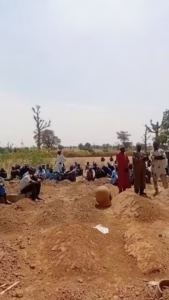
At least 162 people were killed during coordinated attacks on two rural communities in western Nigeria, a lawmaker has confirmed, in what authorities describe as one of the most deadly assaults in the country in recent months. Human rights organisations fear the number of victims may continue to rise as access to the area remains limited.
The attacks took place on Tuesday evening in the villages of Woro and Nuku, located in Kwara State, according to Mohammed Omar Bio, a member of Nigeria’s House of Representatives who represents the affected area. He said armed militants stormed the communities, killing residents and setting homes ablaze.
Bio alleged that the attackers were members of Lakurawa, an armed group believed to be affiliated with the Islamic State network. No militant organisation has officially claimed responsibility for the violence.
Rescue Efforts Hampered by Isolation
Emergency response has been severely constrained due to the remoteness of the affected villages. Ayodeji Emmanuel Babaomo, the Red Cross secretary in Kwara State, said humanitarian workers have been unable to reach the communities.
“The villages are extremely difficult to access,” Babaomo said, noting that they are nearly eight hours’ drive from the state capital and lie close to Nigeria’s border with Benin. “We have reports that scores of people were killed, but confirming details on the ground has been challenging.”
Footage broadcast on local television stations showed disturbing scenes, including bodies lying in pools of blood, some victims with their hands bound, and houses burning across the villages.
Rights Groups Cite Security Failures
Amnesty International said in a statement that more than 170 people may have been killed during the attacks. The organisation accused the gunmen of looting shops, torching homes, and killing civilians indiscriminately.
“The security lapses that allowed these attacks to happen are unacceptable,” Amnesty said, adding that residents had reportedly received repeated threat messages from the attackers for over five months before the assault.
Government Condemnation
(REUTERS)
Kwara State Governor AbdulRahman AbdulRazaq condemned the violence, calling it a “cowardly act” carried out by terrorist groups under pressure from ongoing military operations in the region.
Nigeria continues to battle a complex and evolving security crisis. While Islamist insurgents remain active in the northeast, armed groups and criminal gangs have increasingly carried out kidnappings and deadly raids across the northwest and north-central parts of the country.
Related Violence Elsewhere
On the same day as the Kwara attacks, police confirmed that at least 13 people were killed by unknown gunmen in Doma village, located in Katsina State. Authorities said investigations were ongoing, but no suspects had been identified.
Last week, militants linked to Boko Haram killed at least 36 people in separate attacks on a construction site and a military base in northeastern Nigeria.
Militant Groups and International Response
Nigeria is home to several armed extremist factions, including groups aligned with the Islamic State. These include the Islamic State West Africa Province (ISWAP) and the lesser-known Islamic State Sahel Province, locally referred to as Lakurawa.
The Nigerian military has previously stated that Lakurawa originated in neighbouring Niger and expanded its presence in Nigerian border areas following the 2023 military coup in that country.
Security analyst James Barnett of the U.S.-based Hudson Institute suggested the Kwara attack may also involve the Jama’atu Ahlis Sunna Lidda’awati wal-Jihad (JAS) faction of Boko Haram, which has been linked to previous massacres in the region.
Meanwhile, the head of U.S. Africa Command confirmed that the United States has deployed a small team of military officers to Nigeria as part of broader security cooperation. In December, U.S. forces also carried out airstrikes targeting Islamic State-linked militants in the country.
Nigeria, Africa’s most populous nation, remains under mounting pressure as violence continues to threaten civilian populations across multiple regions.