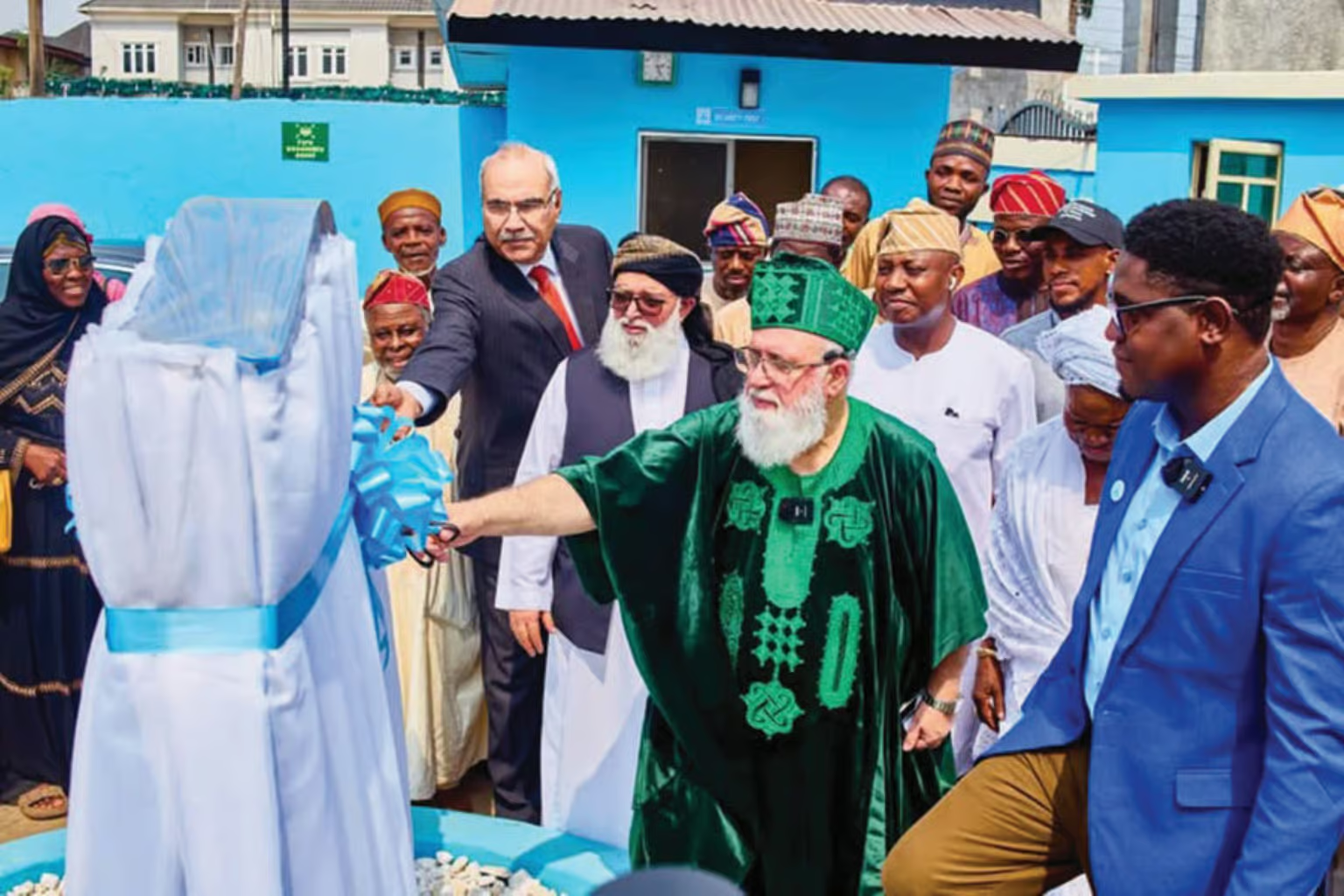

Muslim Hands International (MHI), a UK-based humanitarian organization, has formally opened its first permanent educational institution in Nigeria with the inauguration of the Muslim Hands Toyibat School of Excellence in Lagos.
The development represents a major milestone for the organization, which has operated humanitarian and development programs globally for over three decades but is only now establishing a long-term educational footprint in Nigeria.
A Legacy Rooted in Islamic Education
The newly inaugurated school is located within Medina Estate, Gbagada—an area historically associated with Islamic learning. The Toyibat name carries deep significance in Nigeria’s educational history, tracing its roots to the late Alhaja Toyibat Yusuf, a renowned education pioneer who founded Nigeria’s first private Islamic school in the late 1970s.
By revitalizing the site, Muslim Hands aims to preserve this legacy while adapting it to meet contemporary educational needs.
Education Beyond the Classroom
According to Muslim Hands leadership, the Toyibat School of Excellence is designed to serve orphans and children from disadvantaged backgrounds, offering more than conventional academic instruction.
Speaking at the inauguration ceremony, Syed Lakhte Hassanain, Founder and Chairman of Muslim Hands International, emphasized that the organization’s mission in Nigeria is centered on empowerment, not profit.
“We are not in Nigeria for business. We are here to empower young people through education,” he stated.
Hassanain revealed plans to expand the school into a multidisciplinary training hub, incorporating facilities for Information Technology, mechanical skills, and Artificial Intelligence. These programs are expected to offer intensive training courses lasting between six months and two years, with a strong focus on employability and self-reliance.
Commitment to Inclusivity and Neutrality
Despite its Islamic foundation, Muslim Hands reaffirmed its commitment to inclusivity and non-partisanship. Hassanain stressed that the organization has maintained strict political neutrality throughout its 35-year history.
“Children are the future. When politics enters education, the future is damaged,” he said, adding that the school is open to children of all religious backgrounds.
Lagos State Government Welcomes Partnership
The Lagos State Government welcomed the initiative, describing it as a valuable contribution to the state’s educational development agenda. Orunsolu Ismaheel Adebayo, representing the Commissioner for Basic and Secondary Education, noted that public-private collaboration is essential to meeting Nigeria’s growing educational demands.
“Education speaks a universal language. Partnerships with credible organizations like Muslim Hands are critical to delivering education that combines academic excellence with strong moral values,” he said.
Honoring Community Heritage
The school occupies a property previously overseen by a local family, and the handover was marked by an emotional tribute. Mr. Kola James, son of the late former proprietor, expressed gratitude to Muslim Hands for preserving his mother’s commitment to community service through education.
Part of a Global Education Network
Member of the MHI Board of Trustees, Mawlana Jeelani Ghulam, highlighted that the Lagos school joins a global network of over 100 Muslim Hands schools across 30 countries, underscoring the organization’s broad humanitarian reach.
Meanwhile, Muhammad Zahid Azeez, MHI’s Global Director of Education, disclosed that the organization currently supports more than 600 government-partnered schools worldwide, employing diverse teaching models adapted to local contexts.
Investment in Modern Learning Facilities
Nigeria Country Director for Muslim Hands, Nurudeen Ibrahim, confirmed that initial investments have focused on upgrading science laboratories, improving classroom infrastructure, and creating a learning environment that supports innovation and critical thinking.
A Model for the Future
The event concluded with commendations from leaders of the Muslim Ummah of South West Nigeria (MUSWEN), including Alhaji Rasaki Oladejo and Alhaji Rafiu Ebiti, who described the school as a model for future educational initiatives.
As Nigeria grapples with youth unemployment and skills gaps, the Toyibat School of Excellence is being positioned as a blueprint for technical, vocational, and AI-driven education, offering hope for sustainable youth development across the country.