
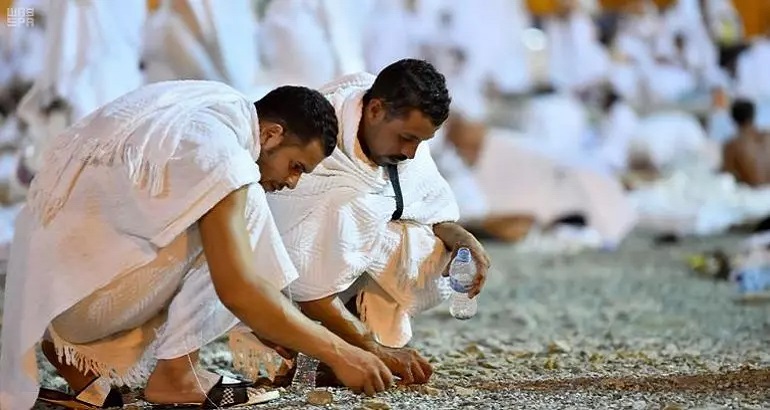

Muzdalifah and Mina: As the Day of Arafah concludes, the journey of the soul continues into the night. Pilgrims now head to Muzdalifah, where they gather under the open sky in humble rest and remembrance. Then they move to Mina, the valley of sacrifice and struggle — where stones are cast against Shaytan and lives are offered for the sake of Allah.
This part of the pilgrimage is a reminder that true faith is not only about tears of repentance, but about resilience, action, and personal sacrifice.
Muzdalifah: Sleeping Under the Sky
After sunset on the Day of Arafah, pilgrims make their way to Muzdalifah — a plain nestled between Arafah and Mina. Here, they pray Maghrib and Isha together, spend the night in the open, and collect pebbles for the ritual stoning of the next day.
READ MORE: Hajj and Umrah: Part 5 – The Day of Arafah: Standing Before Allah
Sleeping without tents, on the ground, under the stars — it is a moment of complete surrender and trust in Allah.
“There is no deity but Allah alone. He fulfilled His promise, helped His servant, and defeated the confederates alone.”
— Takbir of Muzdalifah
Spiritual Lessons from Muzdalifah:
-
Gratitude in Simplicity
After the intense spiritual exertion of Arafah, Muzdalifah is calm. It reminds us to pause and be grateful — for the journey, the forgiveness, and the chance to continue striving. -
Equality and Humility
No five-star hotels or cozy beds. Everyone lies side-by-side on bare earth. The message is clear: we are all servants of Allah, awaiting His mercy. -
Preparation for Jihad al-Nafs
As pilgrims collect their stones, they prepare for jihad against Shaytan — not with weapons, but with their conviction, self-control, and obedience to Allah.
Mina: The Valley of Sacrifice
On the 10th of Dhul Hijjah, pilgrims return to Mina for what is known as Yawm al-Nahr (The Day of Sacrifice). This is one of the most spiritually intense days of Hajj:
-
Stoning the Jamarat (symbolic rejection of Shaytan)
-
Slaughtering an animal (following the example of Prophet Ibrahim عليه السلام)
-
Shaving the head or trimming hair (symbolizing renewal and humility)
-
Tawaf al-Ifadah (returning to the Kaaba)
This day marks the start of Eid al-Adha for Muslims around the world — but for the pilgrim, it is a day of deep personal victory.
The Stoning of the Devil: Rejecting Evil
Pilgrims stone three pillars (Jamarat) representing the devil’s attempts to dissuade Ibrahim عليه السلام from obeying Allah. By throwing stones, pilgrims symbolically reject every whisper, temptation, and weakness that tries to pull them away from righteousness.
Lessons from Jamarat:
-
Confronting the Inner Shaytan
The biggest enemy lies within — our ego, desires, and laziness. Stoning teaches us that we must fight our own shortcomings daily. -
Discipline and Obedience
It may seem like a simple ritual, but its value lies in obedience — doing what Allah commanded, even if we don’t fully grasp the reasons. -
Turning Away from Sin
Each stone thrown is a personal promise: “I will not return to that sin. I will not listen to Shaytan again.”
The Sacrifice: Following the Legacy of Ibrahim عليه السلام
The act of sacrificing an animal is not about blood or meat — it is about the spirit of submission.
“Their meat will not reach Allah, nor will their blood, but what reaches Him is piety from you.”
— Surah Al-Hajj (22:37)
Ibrahim عليه السلام was ready to sacrifice what was dearest to him — his son — because Allah commanded it. That act of obedience became an eternal legacy.
Spiritual Meaning of Sacrifice:
-
Surrendering to Divine Will
Are we ready to give up what we love most for Allah’s sake? Be it money, status, comfort, or bad habits? -
Purification Through Giving
The meat is distributed to the poor — reminding us that sacrifice should also benefit others. -
Renewal of Covenant
Every drop of blood spilled is a reminder: “I am Allah’s servant. My life, my death, and my sacrifices are for Him alone.”
Shaving the Head: The Ego Falls
Shaving the head or trimming the hair is another act of humility. For men, it is sunnah to shave completely; for women, a small portion is trimmed.
The act symbolizes:
-
Letting go of vanity
-
A fresh start
-
Complete submission
The Prophet ﷺ made dua for those who shaved their heads three times more than those who trimmed.
“O Allah, forgive those who shave their heads.”
— Bukhari
Eid al-Adha: The Joy of Obedience
For the pilgrims, Eid is not about new clothes or feasts. It is about the joy of obeying Allah, the completion of rituals, and the beginning of a new self.
For those at home, Eid al-Adha should also be a time of:
-
Gratitude
-
Charity
-
Reflection on the story of Ibrahim عليه السلام and Isma’il عليه السلام
-
A commitment to improve our obedience to Allah
Conclusion: The Soul’s Journey is Not Over
Muzdalifah and Mina are powerful turning points. They show us that repentance must lead to action, and faith must result in transformation.
The pilgrim casts away sin at Jamarat, sacrifices ego at Mina, and walks into a new life with a clean heart.
Coming Up in Part 7: “Tawaf al-Ifadah and the Farewell Tawaf – Returning to the Source”
In the next part of this series, we will dive into the emotional return to the Kaaba, the Tawaf al-Ifadah, and the bittersweet Farewell Tawaf. These final rituals seal the journey of Hajj, reconnect the heart with its true source, and remind us that life itself is a journey to Allah.
Author: Islam Religion Guardian Columnist
Published by: IslamReligionGuardian.com


