
In the realm of medicine, certain ailments resolve themselves. These self-limiting diseases erupt, peak, and eventually fizzle out, often leaving little behind but exhaustion. But when a government treats extremism like a passing virus, assuming it will burn out on its own, the consequences can be devastating.
This is the game Bangladesh’s two dominant political forces—the Awami League and the Bangladesh Nationalist Party (BNP)—have played for decades. They have treated waves of far-right religious militancy as manageable, even useful, political phenomena. A fever to be monitored, not cured.
But now the question looms: what if the virus has mutated?
A History of Calculated Tolerance
Modern Islamist militancy in Bangladesh did not emerge from a vacuum. The 1999 bombing of the cultural group Udichi under an Awami League administration marked an early warning. Yet the movement truly expanded during the BNP’s tenure after 2001, emboldened by the post-9/11 global climate and a domestic narrative that targeted leftist ideologies.
READ MORE: Russian Authorities Target Independent Muslim Community in Occupied Crimea
Despite early alerts, the BNP downplayed the growing threat. Militants struck with near impunity—until their attacks became too conspicuous to ignore. A failed assassination attempt on British High Commissioner Anwar Choudhury and a sweeping wave of bombings across 63 districts, including against the judiciary, finally provoked an official crackdown.
But by then, the damage was done. The cycle had already taken root: radicalism rises, chaos ensues, the state reacts—always too late.
The Illusion of Control
Like a recurring fever, this extremism was never truly defeated—just suppressed until its next resurgence.
In the early 2010s, a chilling pattern emerged: secular bloggers and intellectuals were systematically targeted and killed. Instead of decisive action, the Awami League’s government offered little more than platitudes and vague condemnations. In some cases, it hinted that victims had provoked their own demise.
Only after the horrific 2016 Holey Artisan Bakery attack—where foreign nationals and elite Bangladeshi youth were brutally murdered in Dhaka’s diplomatic zone—did the government respond with full force. But the response was not just about safety—it was about control.
A State Reforged in Fear
What began as a counterterrorism operation evolved into an authoritarian toolkit. Security became synonymous with silence. Suspects began to vanish. Extrajudicial killings were not aberrations but norms. Dissent, whether from journalists, opposition figures, or activists, was swiftly crushed.
This transformation wasn’t accidental. It was strategic. The state began to monetize fear—what many in Bangladesh now cynically refer to as a “militancy business” (jongi bebsha).
By casting itself as a bulwark against radicalism, the ruling party not only gained domestic control but positioned itself as a valuable partner to regional powers like India and global counterterrorism efforts.
Orchestrating Crisis, Profiting from Chaos
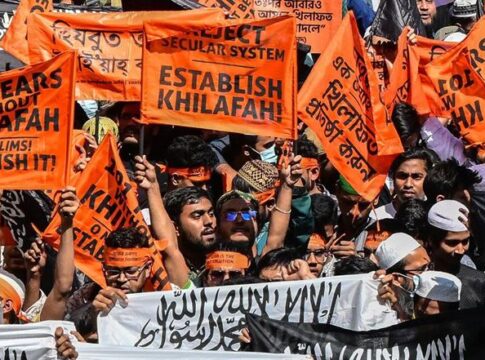
So when extremist mobs return to the streets—burning homes, attacking minorities, issuing threats—the response is rarely swift. Instead, there is a pattern: watch, wait, let panic set in—then arrive as savior.
This isn’t neglect. It’s choreography.
The violence becomes justification for deeper control, validating surveillance laws, internet censorship, and widespread political arrests. The state allows the disorder to crest before stepping in—often brutally—to “restore order.”
The collateral damage? Innocent lives. Students. Writers. Bystanders.
Why the Delay? Apathy and Opportunism

Why does the government consistently wait until things fall apart? Part of the answer lies in how human life is valued in Bangladesh’s political calculus.
Deaths—whether of bloggers, bystanders, or minorities—are often seen as political costs rather than human tragedies. If a handful of lives can create the conditions for consolidating power, then for some, the price is worth it.
Extremism isn’t just a threat—it’s also a tool. It provides pretexts for repression, opportunities to discredit opponents, and a climate in which citizens willingly trade freedom for the illusion of security.
The Tragic Complicity of Silence
But the blame doesn’t lie solely with the state. Civil society bears responsibility too.
Public intellectuals, media voices, and even the urban middle class have largely gone silent. When someone disappears, there are murmurs—but rarely outrage. When mobs attack minorities or militants resurface, there is hand-wringing, not action.
This apathy creates the perfect environment for repression to flourish.
As political theorist Machiavelli once wrote of disease: “In the beginning it is easy to cure but hard to detect; in the end, easy to detect but hard to cure.” The same could be said of extremism.
Bangladesh’s Critical Juncture
Today, Bangladesh faces a stark choice.
The symptoms are visible. The cycle is known. And yet, the machinery of power continues to function as if the system is invincible. But how many more waves of violence can the country withstand before institutions begin to collapse entirely?
If the public continues to stand by—silent, paralyzed—then it is not just the government perpetuating this cycle. It is all of us.
The virus no longer lives in the margins. It has entered the bloodstream of the state.
And unless the nation chooses to treat the disease—not just manage its symptoms—it may not survive the next mutation.