At the fringes of Qatar’s ambitious Education City stands an architectural first in the Muslim world: a purpose-built, contemporary mosque designed exclusively for women. The Al-Mujadilah Center and Mosque, created by the renowned architectural firm Diller Scofidio + Renfro, redefines what a mosque can look and feel like—while honoring its spiritual essence.
This mosque isn’t just a structure. It’s a statement—a celebration of inclusion, intentional design, and spiritual tranquility.
A Mosque Like No Other
In a cityscape often dominated by towering structures and sprawling, hyper-modern developments, the Al-Mujadilah Mosque offers a graceful contrast. With its gently curved concrete roof resembling a floating sheet, the mosque conveys softness and serenity, all while serving as a spiritual and communal center for Muslim women.
READ MORE: Religious Minister Condemns Surau for Ejecting Worshipper, Urges Compassion in Mosques
The flowing roof form isn’t simply an aesthetic gesture—it responds thoughtfully to the functions below, adapting its curves to create expressive spaces for worship, study, and gathering. Suspended gracefully above a garden-like courtyard, it offers both shelter and openness—a poetic balance in Doha’s arid climate.
Designing for Faith and Function
What sets the Al-Mujadilah Mosque apart is its deliberate design for women—a rarity even in the modern Islamic world. Most mosques offer separate or marginal spaces for female worshippers, often in confined balconies or side rooms. In contrast, this structure places women at the center of its purpose.
The building’s layout is unique: while the outer roof aligns with the orthogonal grid of Education City, the inner prayer hall rotates 17 degrees to face the qibla, the sacred direction of Mecca. This subtle yet meaningful shift creates a dialogue between place, faith, and geometry.
Rooted in Visionary Leadership
The mosque owes its existence to the vision of Her Highness Sheikha Moza bint Nasser, Chairperson of Qatar Foundation and a key figure behind Education City. Her initiative to create a space specifically for women aligns with broader efforts to diversify Qatar’s cultural and educational landscape beyond its economic wealth.
Education City is a bold experiment—a 12 km² campus that houses global universities, research institutions, and architectural landmarks. Amidst its glittering collection of structures by world-renowned architects, Al-Mujadilah stands out—not by scale, but by soul.
Architectural Poetry in Motion
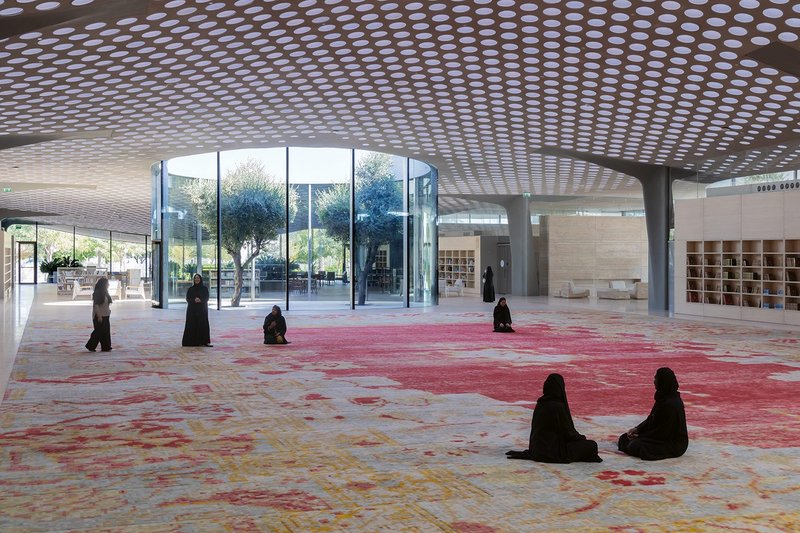
The mosque’s roof is more than a structural element—it’s a symbol of sanctuary. Perforated skylights delicately filter Qatar’s intense sunlight, creating a calm interior glow. The roof’s undulations echo the flow of fabric, invoking the softness of a prayer rug lifted by the breeze.
Inside, the prayer hall is airy and expansive. Rather than a grand, embellished mihrab, the qibla wall undulates subtly—an understated gesture of reverence. Above, a wash of light gently marks the spiritual center.
The floor is adorned with a pixelated, red-toned prayer carpet designed to accommodate up to 750 worshippers. Its pattern, derived from individual prayer rugs, offers worshippers personal spatial cues—an intentional design to help women feel grounded in the open space.
Beyond Worship: A Center for Learning and Reflection
Complementing the prayer hall are spaces for education, reflection, and community. An airy ablution area opens onto the landscaped courtyard—breaking away from the typically enclosed, dim spaces assigned to women in traditional mosque design.
A library and classrooms complete the facility, offering quiet areas for learning and spiritual enrichment. Surrounding dunes serve both practical and symbolic roles—blocking the urban sprawl and evoking the peaceful seclusion of a walled Islamic garden.
The journey from the outer sandy edges into the green inner gardens mirrors a spiritual passage, from the chaos of the outside world into a divine sanctuary.
The Modern Minaret: Technology Meets Tradition
Perhaps the most visually striking feature of the Al-Mujadilah Mosque is its reinterpretation of the minaret. A sleek, vertical structure reminiscent of the Skylon from Britain’s 1951 Festival, it floats above a circular base framed with wooden seating.



The call to prayer emanates from speakers that rise in a choreographed movement, echoing the ascent of a muezzin climbing traditional steps. Encased in a metal mesh inspired by mashrabiya screens, the tower blends retro-futurism with Islamic symbolism in a surprising, albeit controversial, visual metaphor.
A Place of Calm Amid Urban Disarray
In a city designed more for cars than pedestrians, and in a region where vast buildings often dwarf the human experience, the Al-Mujadilah Mosque feels like a refuge. Its human scale, attention to light and shadow, and gentle detailing offer a counter-narrative to the overwhelming urban condition.
Yet, this serenity raises complex questions. While the mosque provides an empowering space for women, its access is limited by its very design. Intended as a women-only mosque, it solves one issue—exclusion from main mosque spaces—while potentially introducing another: the inaccessibility of this beauty to the broader public.
Final Thoughts
Al-Mujadilah Mosque is not merely a building—it is a milestone. A place where architecture meets purpose, where faith finds a new form, and where women are not afterthoughts but central to the design.
It stands as a powerful reminder: places of worship can evolve. They can reflect modern values without losing spiritual integrity. And most importantly, they can be places not just of prayer, but of dignity, inclusion, and hope.