The fragile relationship between South Asia’s nuclear-armed neighbors—India and Pakistan—is under renewed strain after a tragic and brutal assault in Kashmir, which left 26 people dead, most of them Indian tourists. The attack, which took place on April 22 in the scenic town of Pahalgam, has drawn international attention and intensified regional tensions that many fear could lead to military escalation.
The Kashmir Attack: What Happened?
The attack occurred in Pahalgam, a popular destination nestled in the Himalayas, where holidaymakers were enjoying a peaceful retreat. Eyewitness accounts describe how gunmen opened fire, reportedly after identifying victims based on their religious affiliations.
Among the victims were 25 Indian nationals and one Nepali citizen, with the majority being Hindus. A local Muslim tour guide who offered horse rides also lost his life.
Indian Prime Minister Narendra Modi condemned the assault and pledged to “track down the perpetrators to the ends of the Earth.
Alleged Perpetrators and Pakistan’s Denial
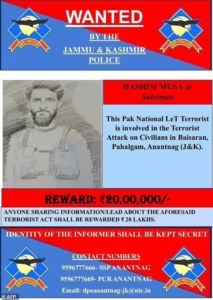
Indian security forces have identified three suspects in the attack—two reportedly from Pakistan and one from India. Authorities allege the trio are affiliated with Lashkar-e-Taiba (LeT), an organization banned by the United Nations and accused of orchestrating the 2008 Mumbai attacks.
READ MORE: Two Men Booked Under UAPA for Beed Mosque Explosion
While no group has officially claimed responsibility, Indian officials assert that the attack bears the hallmarks of cross-border terrorism. In response, Islamabad has denied any involvement, labeling New Delhi’s claims as “baseless” and calling for an impartial international investigation.
The Kashmir Dispute: A Longstanding Flashpoint
The Kashmir region, predominantly Muslim, has remained a deeply contentious issue between India and Pakistan since both nations gained independence in 1947. While the territory is divided between the two countries, both claim it in full.
A separatist insurgency has simmered in Indian-administered Kashmir since 1989, with New Delhi accusing Pakistan of backing militants—a charge Pakistan has consistently denied, insisting instead on its support for Kashmir’s right to self-determination.
India’s Response: Diplomatic and Military Moves
In reaction to the Pahalgam attack, India has launched a series of strong countermeasures, including:
-
Suspension of the Indus Waters Treaty, a long-standing water-sharing agreement.
-
Closure of key border crossings and the downgrading of diplomatic ties.
-
Expulsion of Pakistani nationals, excluding diplomats, with an April 29 deadline.
-
Mass security operations resulting in over 2,000 detentions.
-
Demolition of suspected militants’ homes, a move criticized by some as a form of collective punishment.
-
Banning of several Pakistani YouTube channels accused of inciting unrest.
Pakistan’s Reaction: Retaliation and Warnings
In a swift counter-response, Pakistan expelled Indian diplomats, suspended visa services for Indian citizens—except for Sikh pilgrims—and closed its airspace to Indian airlines.
Pakistan’s defence minister warned that any disruption to Indus River water flow from India would be considered an “act of war”, and claimed the military is on heightened alert to counter any Indian aggression.
The Road Ahead: A Looming Conflict?
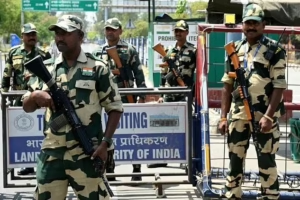
Tensions continue to spiral, with daily cross-border gunfire reported along the Line of Control (LoC) for five consecutive nights. Analysts and observers worry that the region is once again on the brink of a larger conflict.
The last major escalation occurred in 2019, after the Pulwama bombing killed 40 Indian paramilitary personnel. India responded with air strikes deep into Pakistani territory, marking a significant escalation in hostilities.
Whether cooler heads will prevail in 2025 remains uncertain, but the recent violence underscores the volatile nature of Indo-Pak relations—and the ever-present danger Kashmir poses as a geopolitical flashpoint.
Conclusion
As the world watches closely, the Kashmir attack has reignited an already smoldering dispute between two of Asia’s most powerful nations. With both sides exchanging diplomatic barbs and military threats, the next few weeks will be critical in determining whether the situation stabilizes or spirals further into confrontation.