
Traveling can pose significant challenges for Muslims who are committed to performing their daily prayers, especially when the journey involves flying. Observing Solat (prayer) while on a plane requires understanding, preparation, and sometimes improvisation. This guide provides practical steps and advice on how to maintain your spiritual obligations without compromising the sanctity of your prayers.
The Importance of Solat
For Muslims, Solat is one of the Five Pillars of Islam, performed five times a day at prescribed times. These prayers are a direct link between the worshipper and Allah, embodying devotion, discipline, and spiritual mindfulness. Neglecting this duty is not an option, even when traveling, as it is a testament to one’s faith and commitment.
Understanding the Flexibility in Prayer While Traveling
Islam provides flexibility for travelers through concessions such as Qasr (shortening the prayers) and Jam’ (combining the prayers). When traveling, Muslims can shorten the four Rak’ah (units of prayer) prayers to two Rak’ahs. Additionally, certain prayers can be combined. For instance, Dhuhr and Asr can be prayed together, and Maghrib and Isha can also be combined.
Pre-Flight Preparations
1. Planning Your Schedule:
Before you board the plane, plan your prayer schedule according to the flight’s departure and arrival times. Use a prayer time calculator or app to determine the prayer times for both your departure city and destination. This helps in understanding which prayers will need to be performed in-flight.
2. Performing Ablution (Wudu):
It’s advisable to perform Wudu before boarding the plane to avoid the difficulty of doing so in-flight. Airports usually have prayer rooms equipped with Wudu facilities. If performing Wudu in-flight becomes necessary, you can use a small bottle of water or moist towelettes, ensuring you adhere to the required steps as much as possible.
In-Flight Prayer Procedure
1. Finding a Suitable Space:
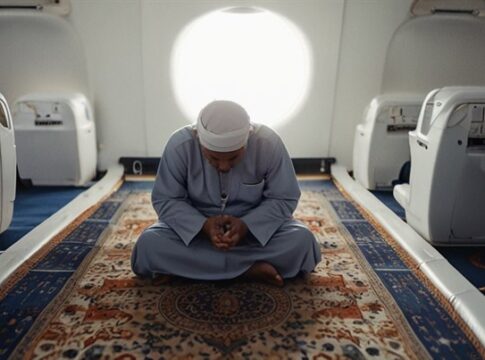
Upon boarding, identify a suitable area where you can perform your prayers. While it’s not always possible to find a large, private space, the back of the plane near the restrooms is often less crowded. Politely inform the flight attendants about your need to pray, as they may assist you in finding an appropriate spot and ensure your privacy.
2. Direction of Qibla:
Determining the Qibla (direction of prayer towards the Kaaba in Mecca) while flying can be challenging. There are several smartphone apps that use GPS to show the Qibla direction. Alternatively, you can ask the flight crew for the direction of Mecca based on the plane’s current position.
3. Performing Prayer in Your Seat:
If standing is not possible due to turbulence or space constraints, you can perform your prayers seated. Ensure that your body and clothes are clean, and try to face the Qibla as much as possible. Begin your prayer with the Takbir (saying “Allahu Akbar”) and proceed with the recitations and movements. You can perform the bowing (Ruku) and prostration (Sujood) by bending forward and using gestures.
Special Considerations
1. Maintaining Concentration:
Maintaining focus during prayer on a plane can be difficult due to the noise and activity around you. Use noise-canceling headphones if needed, and try to immerse yourself in the recitation and the spiritual significance of the prayer.
2. Dealing with Delays:
Flight delays can disrupt your prayer schedule. If a delay causes you to miss a prayer time, you can perform Qadha (making up missed prayers) as soon as possible after the flight. Combining prayers (Jam’) is also a practical solution if you anticipate delays.
3. Health and Safety:
Your health and safety are paramount. If the seatbelt sign is on or there is significant turbulence, remain seated and perform the prayer gestures as safely as possible. Allah understands the constraints and challenges you face while traveling.
Post-Flight Considerations

1. Completing Missed Prayers:
Once you reach your destination, assess if any prayers were missed or performed in a rushed or incomplete manner. Make up for these prayers (Qadha) to ensure that you maintain your spiritual obligations.
2. Re-establishing Routine:
Travel can disrupt your routine. Upon arrival, promptly return to your regular prayer schedule. Find a local mosque or designated prayer area if you’re in a public place, and connect with the local Muslim community for support and guidance.
Conclusion
Performing Solat while traveling on a plane requires preparation, flexibility, and a strong sense of devotion. By understanding the concessions Islam provides for travelers and making use of modern tools and resources, you can maintain your spiritual obligations without compromising the integrity of your prayers. Remember, the effort you put into preserving your connection with Allah, even amidst the challenges of travel, is highly valued and rewarded. Safe travels and may your journey be filled with blessings and spiritual fulfillment.