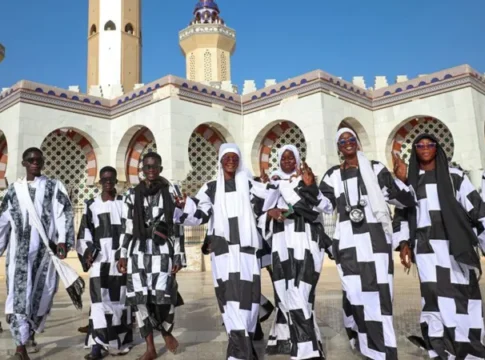

As the sun sets over the serene village of Mbacke Kadior in central Senegal, a unique rhythm fills the air. In a circle outside a modest mosque, a group of devoted worshippers dressed in vibrant patchwork garments chant harmoniously. These are the Baye Fall, a fascinating subgroup of Senegal’s Mouride brotherhood.
Their swaying bodies, dreadlocks swinging with each movement, reflect their fervent dedication. This ritual, known as the “saam fall,” is both a spiritual celebration and an act of devotion. Lasting up to two hours, it occurs twice weekly, immersing participants in a near-trance state.
Unlike traditional Muslim practices that emphasize daily prayers and fasting during Ramadan, the Baye Fall express their faith through hard work and community service. For them, spirituality lies in action, not ritual.
A Distinctive Path of Faith
The Baye Fall trace their origins to Ibrahima Fall, a devoted follower of Cheikh Ahmadou Bamba, the founder of the Mouride brotherhood in the 19th century. Fall’s life of complete service to Bamba became the cornerstone of Baye Fall philosophy. He prioritized labor and devotion to others over personal rituals like fasting or regular prayers.
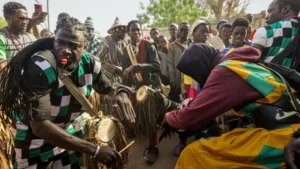
This commitment to selfless work is symbolized by their distinctive patchwork clothing, which originated from Fall’s tattered garments—a reflection of his humble lifestyle. Today, Baye Fall members proudly wear these colorful creations, viewing them as a representation of universality and unity.
Faith in Action
For the Baye Fall, every task—whether farming, constructing schools, or crafting garments—holds spiritual significance. Their devotion extends beyond the mosque, with many engaging in initiatives like social businesses and cooperatives aimed at fostering sustainable development.
“Work is our prayer,” says Maam Samba, a Baye Fall leader in Mbacke Kadior. “Every action, done with love and respect, brings us closer to God.”
The group also contributes to Senegal’s economy by producing and selling patchwork clothing. Women dye fabrics in bold, vibrant hues, while men skillfully sew them into garments that represent the Baye Fall identity. These creations are sold in markets across the country, sustaining livelihoods and sharing their philosophy.
Facing Misconceptions
Despite their contributions, the Baye Fall are often misunderstood. Some accuse them of straying too far from Islamic norms, and false perceptions—such as claims of alcohol and marijuana use—have further complicated their image.
Adding to the challenge are individuals referred to as “Baye Faux” (false Baye Fall), who adopt the group’s distinctive appearance but fail to contribute to their community-oriented values. This has sparked criticism from within and outside the group.
A Global Influence
The Baye Fall’s philosophy has attracted followers worldwide. Among them is Fatima Batouly Bah, an American who embraced their way of life after visiting Senegal in 2019. Meeting a Baye Fall leader changed my life,” she shares. Their devotion through work and service resonated deeply with me.
Bah now lives in Senegal, contributing to community projects and embodying the group’s ethos of faith through action.
A Vital Role in Senegal
In addition to their spiritual practices, the Baye Fall play an essential role in Senegalese society. They maintain the Grande Mosque in Touba, the Mouride brotherhood’s spiritual hub, and ensure security during significant events like the annual Magal pilgrimage. Their presence commands respect and order.
However, the group faces challenges. Limited resources hinder their ambitious plans for sustainable development and job creation—efforts they see as crucial for addressing Senegal’s economic challenges and curbing youth migration.
“We aim to provide opportunities for young people,” says Samba. “With collaboration from governments and international organizations, we can achieve even more.”
Looking Ahead
Despite facing criticism and resource limitations, the Baye Fall continue to leave a profound impact on Senegal’s cultural and religious landscape. Their vision—a harmonious blend of faith, labor, and community service—offers a unique model of spirituality and development.
For the Baye Fall, the path to heaven is paved not with ritual but with dedication, hard work, and service to others. Their journey is a testament to the idea that spirituality can thrive in action, reshaping both lives and communities.